
An Uaithne, 1991, Image Nigel Brand
ANÚNA was born as An Uaithne on an Autumnal evening in Dublin in 1987. According to Michael McGlynn its founder and Artistic Director.
“I’d spent the five years since leaving school absorbing as much music as I was capable of retaining. Those few years had introduced me to medieval and contemporary music through my studies in University College Dublin, but more crucially I had been exposed to the sheer wonder of choral music for the first time and I desperately wanted to express and broadcast this beautiful new discovery to anyone that would listen.
I created An Uaithne blissfully unaware of the need for the classical music industry to put music into boxes. To me music was all the same. I could shuffle on the same cassette tape from Debussy to David Bowie, from Clannad to Ligeti, from Machaut to The Clash. Each piece for me, regardless of the so-called genre of it, had its own story and each story had a validity all of its own. I suppose it is my lack of willingness to accept that music needs to be categorised and filed into boxes that defines the ethos of ANÚNA today. Back in 1987 my ignorance of such things, coupled with a passionate desire to create a form of choral music to suit my own personal vision, gave birth to something which ultimately has changed my life.
The first performance by An Uaithne was in September 1987 in Trinity College Dublin. I had been accepted to Trinity to study for a Master’s degree in English Literature and immediately joined the chamber choir there called Trinity College Singers. Eventually I became the conductor, but a lack of auditionees from the Music department and from the previous year’s ensemble resulted in me being forced to reach out to the entire college to find singers for the group. Although it was initially dispiriting, it actually worked out for the best. When the student body realised that the group was accessible to everyone, places were very quickly filled with an assortment of people from every part of the university.
Even at this very early stage I felt that a chorus whose members were on an adventure together and had minimal experience of choral music was preferable to singers who came with expectations that I personally had little interest in accommodating.
I was never less than ambitious and have nothing but happy memories of this group. Crucially, An Uaithne grew out of this ensemble to help fill out our concert programmes and also to perform more challenging material with a smaller group”
After leaving Trinity, An Uaithne expanded and developed, and the concerts became more unconventional.
“I remember an early concert of An Uaithne that featured Henry Purcell’s Ode to Saint Cecilia paired with Benjamin Britten’s “Hymn to Saint Cecilia” in the first part of the concert and a collection of medieval and Irish songs, which included one of my own, but also featured choral arrangements I had done of pieces by the Irish group Clannad. The finale of that concert was in front of a full house at St. Ann’s Church in Dublin, a raucous cacophony of viols, recorders, harps and singers lashing out Clannad’s arrangement of “Dúlamán”.
The mainstream music audience in and around Dublin began to pay attention to the group and a healthy buzz could be felt around the concerts. They even released an unimaginatively titled cassette that is now somewhat of a collector’s item. In December 1990 the choir recorded a track with Producer/Engineer Brian Masterson,who remains Michael’s chief recording collaborator today. In 1991 a concert at Dublin's Project Arts Centre heralded a crystallisation of all the ideas that had been floating around up to that time.
“The music itself was pretty eclectic, something that has sustained the ensemble over thirty years. I had grown so much in confidence myself that the bulk of the concert featured my own compositions.
We presented a “show” rather than just a concert, with movement, lights and sound amplification. Even the weak puddle of dry ice that managed only to splutter across the edge of the stage was more-than-a-bit thrilling to behold and the overall performance probably one of the most avant garde presentations that we have done. The concert included the first performance of "The Rising of the Sun", specially commissioned by the Project Arts Centre and a collection of contemporary Irish choral music by various composers. The response to my own music was overwhelming and it gave me the confidence to focus on arrangements and original compositions of my own.
Michael’s brotherJohn McGlynn joined the group at this point bringing a common sense approach to the performances.
“He kept drawing me back to the fact that elitism should have no place in any genre of music, constantly emphasising that there was no point in doing this at all if it couldn’t be communicated to everyone rather than the few who claimed to appreciate and understand choral music.
At this time I began to explore the connections between music and ritualistic movement. Movement has historically been part of communal music making, from the earliest era of the Christian Church through to the processions and secular dramas that became popular in the Middle Ages.
While many choirs move in performance none move quite like we do. So much is dependent on the space we sing in, the connections inherent in the spaces we inhabit as artists. Singing into the space encouraged me to create music designed for movement and space. Many of the works that define ANÚNA today were developed during this time and how something is presented to the audience has become more important than technical perfection”.
Anyone who has seen ANÚNA in performance will probably have seen them perform Michael’s arrangement of the Irish song “Jerusalem”.
“I’ve never spoken about the creation of this piece before. The first performance of the work was in 1991 in Trinity College Dublin Chapel. I wanted to emulate the sounds of the sea, undulating and whispering. But nothing ethereal. It had to be forceful and powerful, still and yet ever-changing.
I had already experienced Gaelic Psalm Singing and that had inspired me to approach this work in a similar way, with a cantor and response. Psalm singing is about a congregation of voices, each singing its own hymn of adulation, but unified in a spectacularly random way.
Most of all the arrangement had to be simple.
We tried performing ”Jerusalem” static at first with the women placed all over the venue, but it was the simple act of getting them to walk around the space that was the key to the magic. The voices moving so close to the audiences, the singers each identifiable and unique. Human and yet producing a sound that was almost inhuman when combined. Singing alone, but unified with one intent.
I can’t describe my reaction adequately, but a humble, slightly stumbling performance opened up a gateway to something that I still don’t understand fully”.
1991 also produced Michael’s "Celtic Mass" which contains the essence of the past and future of An Uaithne, and it was at this point that the group changed its name to ANÚNA.
“The Celtic Mass was a commission originally and ended up being a compilation of different pieces loosely woven together. Hidden within it were ideas that still obsess me today. The cold, inhuman voices of the angels of “Sanctus” contrast with the muscular exclamation of the “Kyrie”. The Celtic Mass probably contains an essence of many of the things I wanted to say about the nature of music.”
In October 1992 the first ANÚNA demo recordings were made in Windmill Lane Studios yielding the tracks "Salve Rex Gloriae" and "The Rising of the Sun". Collaborations arose with Sting and the Chieftains on the Grammy Award willing album “The Long Black Veil” and their voices gracedthe soundtrack of the Sullivan/Bluth animated film Thumbelina, a classic of the period, which they recorded with Barry Manilow.
“Here we were, a group of very young, very inexperienced singers recording for someone who was beyond a legend. He said nothing at the start of the session. I suppose our utter lack of perspective allowed us to think we were capable of doing something that there were professional choruses for in London and Los Angeles.
But I do remember when that particular sound we make began to show through the bad sight-reading and technical problems after a long period of silence from the control room. He started to talk, and even managed to sound excited by the end of the session.
Trinity College Singers 1988
An Uaithne 1990
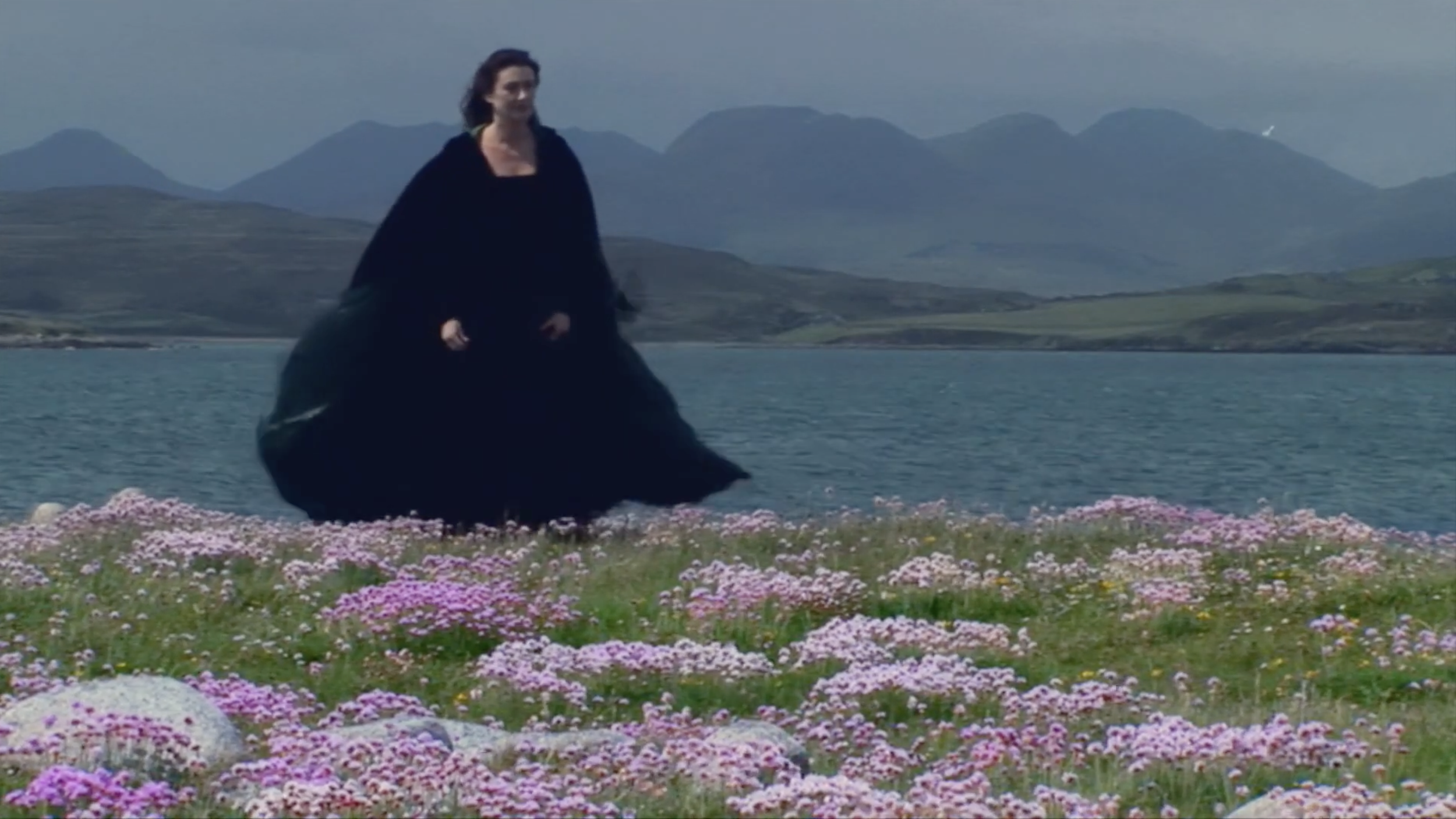
1994: Pic Des Muckian
1993: Pic Nigel Brand
The cover of our first cassette release, 1990 & 1991 (designed by Brendan Donlon)
At that stage I felt it was time to record some kind of proper commercial album. Having created a unique repertoire I brought ANÚNA into a cold church in February 1993 (the first of many cold churches), sixteen singers in total. I didn’t quite have enough material for an album so I rushed off three tracks in the few days before the recording, writing “The Raid”, “Invocation” and an arrangement of the classic traditional song “‘Sí do Mhaimeo Í”. All of them were presented to the group in the church on the day of the recording. We completed the album, imaginatively titled ANÚNA, in four hours with a single stereo microphone. “Media Vita” was the album opener and it announced itself with a fresh and energetic voice.
It is hard to pinpoint which tracks were “unique” to ANÚNA. There were elements of many different voices there with a strong bias for traditional settings. However if I was to pick a piece it would be “Invocation”. This was something new. The poem it is based on formed the inspiration of the next ANÚNA album, and the ideas hidden within it, procured from sources as eclectic as Robert Graves’ “The White Goddess” and “The Idea of Order at Key West” by Wallace Stevens, formed the basis for much of what has obsessed me as a composer to this day.
The record was released in Ireland a few weeks later with no promotion. It slowly picked up traction, eventually selling many tens of thousands of albums and achieving a top 11 placing on the Billboard World Music Charts in the USA. But by the time the album was out I had moved on. This next release was to be something very new, very special”
“Media Vita” from A Celtic Celebration, solo & arranged by Michael McGlynn. Directed by Maurice Linnane (1995)

ANÚNA, 1993. Cover design Brendan Donlon

Invocation, 1994. Cover design Brendan Donlon
ANÚNA released their second CD entitled Invocation in August 1994. The album subsequently went on to win a National Entertainment Award for Classical music that December.
“I was contacted by a very well known US based label at that time, and they flew me to the States for a meeting. I brought the ten track recording of Invocation with me. We sat with all of the company listening to this strange and evocative record. There was silence at the end of it and a single voice said “I have no idea how I would even begin to go about selling that to anyone”. So to soften the blow somewhat I went back and added four new tracks to the album which featured more “accessible” pieces. Eventually we signed to Celtic Heartbeat/Atlantic Records for a three album deal.
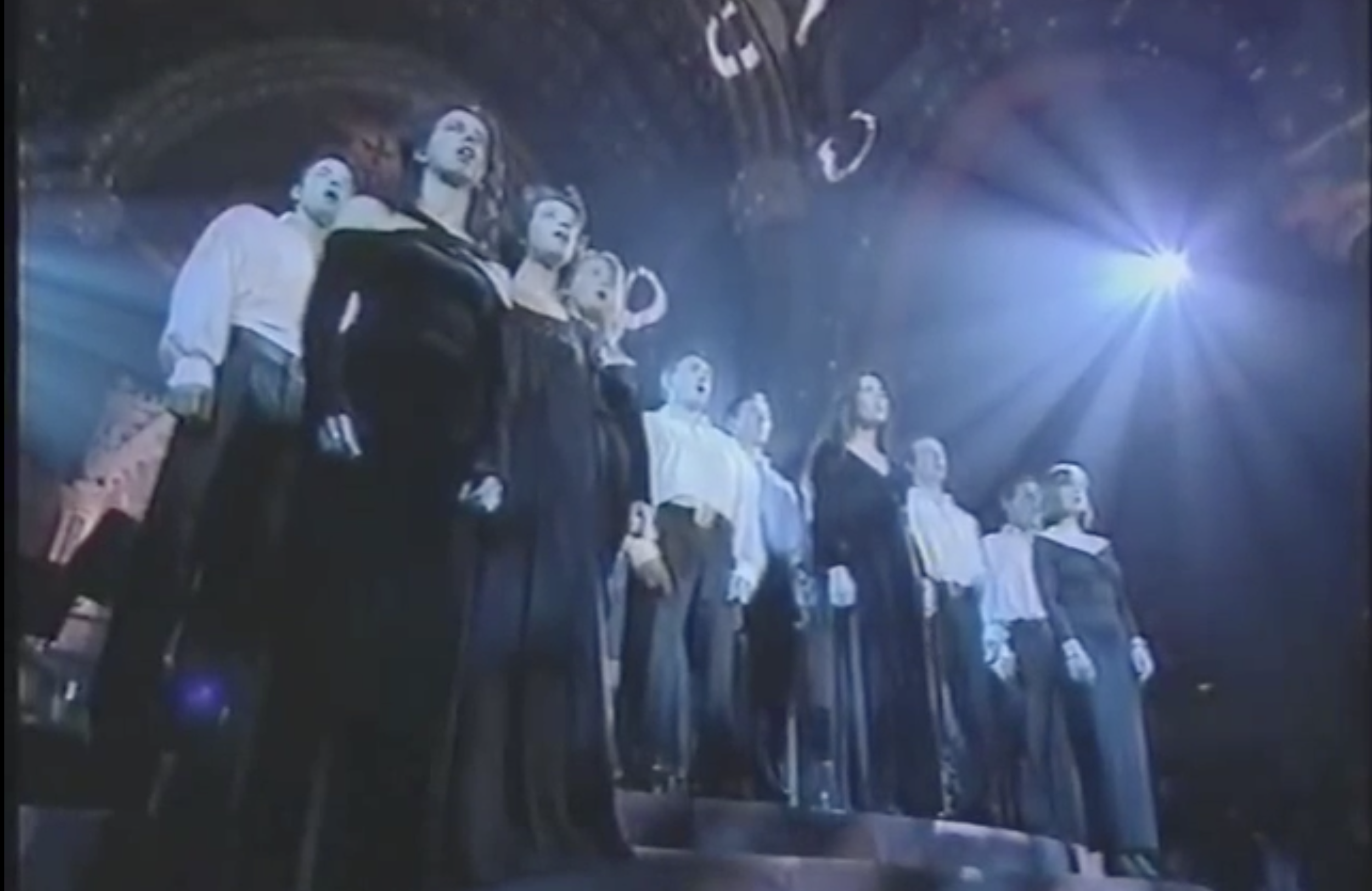
"Songs of Praise" BBC TV 1994, live from Clonard, Belfast.
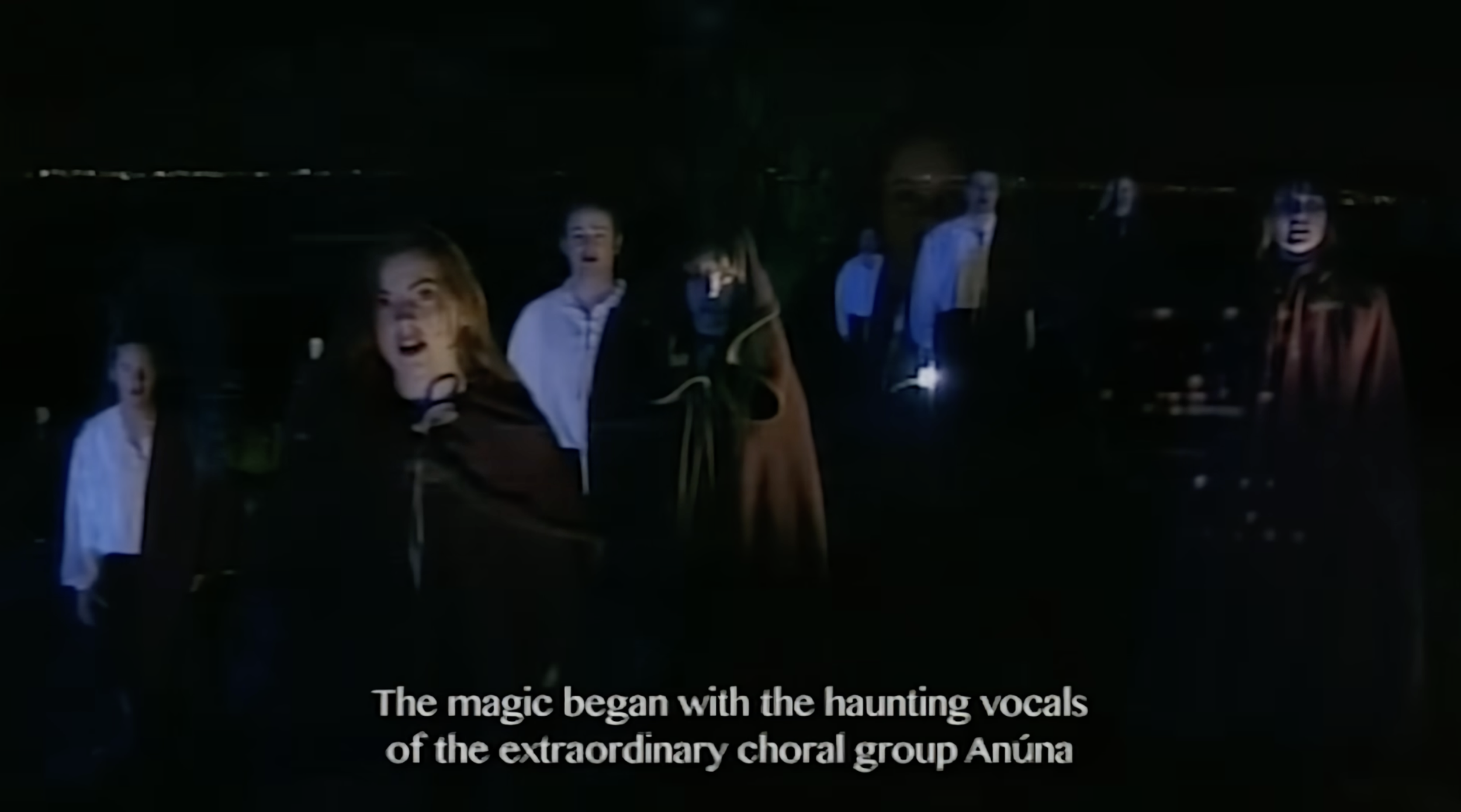
In May 1994 a seven minute interval segment was broadcast as part of the Eurovision Song Contest in Dublin entitled Riverdance. ANÚNA featured at the opening of the work, performing a two minute segment entitled “Cloudsong”, soloist Katie McMahon, with music written by Bill Whelan.
“I remember that night very well mainly because, despite the hype-in-hindsight, no one actually had much of an inkling that Riverdance would eventually become a world-wide phenomenon. Bill had attended numerous ANÚNA performances and included us in his cantata The Spirit of Mayo in 1993. He was also very familiar with my own compositional voice. It was all just a happy accident, and one I will always be proud of having been a seminal part of”.
Eventually the single spent 18 weeks at number one in the Irish charts, went top 10 in the British charts and resulted in a hugely successful stage show and video. However the soundtrack album that was initially released did not feature ANÚNA.
“I couldn’t reach agreement with the record label, so we were excluded from the initial release of the album. Instead it was recorded with a group of session singers. At that stage I couldn’t see any reason for ANÚNA to continue with Riverdance : the Show and informed the producers that we would not be continuing with the production simply because the album being sold at the door of the venue and played on the radio did not feature the actual group who were on stage. Eventually an accommodation was reached between the record company and ourselves and happily the new disc included us on four tracks - “Riverdance”, “Shivna”, “The Heart’s Cry” and “Home and the Heartland”. It was our version was released in the USA and subsequently all over the world. It won a Grammy Award in 1996.”
Anúna Performing in Riverdance in Dublin, 1995. Image Andrew McGlynn

ANÚNA 1995
Cover Shoot for the Róisín Dubh Single, 1995. Image Nigel Brand
Michael with Elvis Costello at Meltdown 1995
In January 1995 the group made their first of many appearances at the embryonic Celtic Connections at Glasgow Royal Concert Hall, winning the award for "Most Popular Public Performance of the Year". The same year they recorded an interview with Michael and two songs for a television special for PBS in the USA as part of a show called "A Celtic Celebration". This was the first time ANÚNA came to the attention of the US public and the choral fraternity there sat up and took notice of the ensemble.
“Even a quarter of a century after their first encountering ANÚNA people still tell me what a huge influence the music has had on their lives. My own musical and personal life has been strongly defined by the music I listened to as a young man, so it is a strange thing when I am told that my own music, and the sound of ANÚNA, has had profound effects on people all over the world. This is probably the least expected, and most valued outcome of my work as a musician.”
In June they were invited by Elvis Costello (Declan MacManus) to perform as his guests at Meltdown on London's South Bank.
“This Festival holds very special memories for me. The concert was in The Queen Elizabeth Hall and took place while we were involved in the massively successful run of Riverdance the Show at the Hammersmith Odeon that hot summer of 1995. We basically had to divide in two, with some of the group coming from Hammersmith and a few from Ireland. I remember rushing across London on the Tube with Katie in her ANÚNA dress. We had just been told that The Sabri Brothers, who were sharing the bill with us, had cancelled due to illness. Declan and I hastily organised a new concert programme, with him leading a house band I think and then we sang an arrangement I made of “She Moved Through the Fair” with Declan on lead. It was a fantastic night. Also at Meltdown he asked me to arrange a piece I loved of his, “London’s Brilliant Parade” for a concert. It was there that I met Jeff Buckley, sharing a stage with him in a concert of English song that featured Fretwork, who I sang some Lute songs with. I’d seen Jeff the week before on TV singing “Grace” and I was completely blown away by his brilliance. I’m not known to be diplomatic so i went straight up to him and told him. We ended up having a duel in the toilets of the QEH to see who could sing the highest… He performed “Grace” that night for me at the gig, improvised a guitar part and it was transcendent. There won’t be another like him. We had a wild night after the concert in London. And then he was gone. His tragic death inspired the later album Behind the Closed Eye (1997) and I dedicated the piece “Where All Roses Go” to him.It was somewhat serendipitous that his death was around the same age as the poet who wrote that text, Francis Ledwidge when he died. And I was the same age as them both. One of the darkest things I’ve every written.”
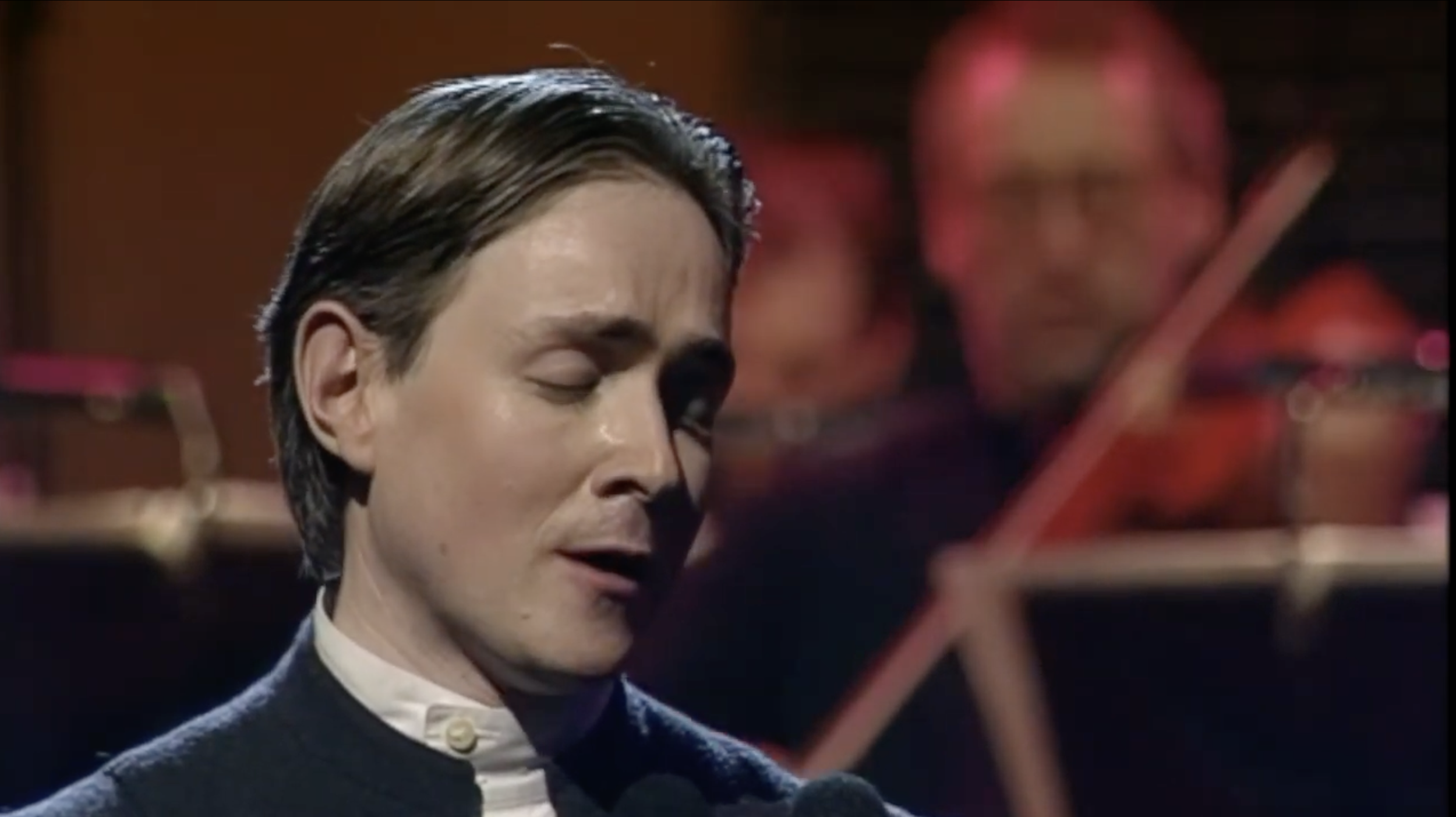
“Where All Roses Go”, with The Ulster Orchestra 1999
ANÚNA’s third album Omnis was released in October 1995.
“We had an ever increasing following in Ireland, building steadily for seven years, when Riverdance catapulted the group forward onto an international stage in an unprecedented manner with all the commercial trappings attached. We migrated from audiences of 3-400 to 4000 seater venues in just a few months. In the middle of all this I hung doggedly to my own music, creating Omnis to keep my feet firmly planted on the ground. The singers in the group who remained with Riverdance were, understandably, drifting away from ANÚNA, so it ways the album was the swansong for that era of the group.
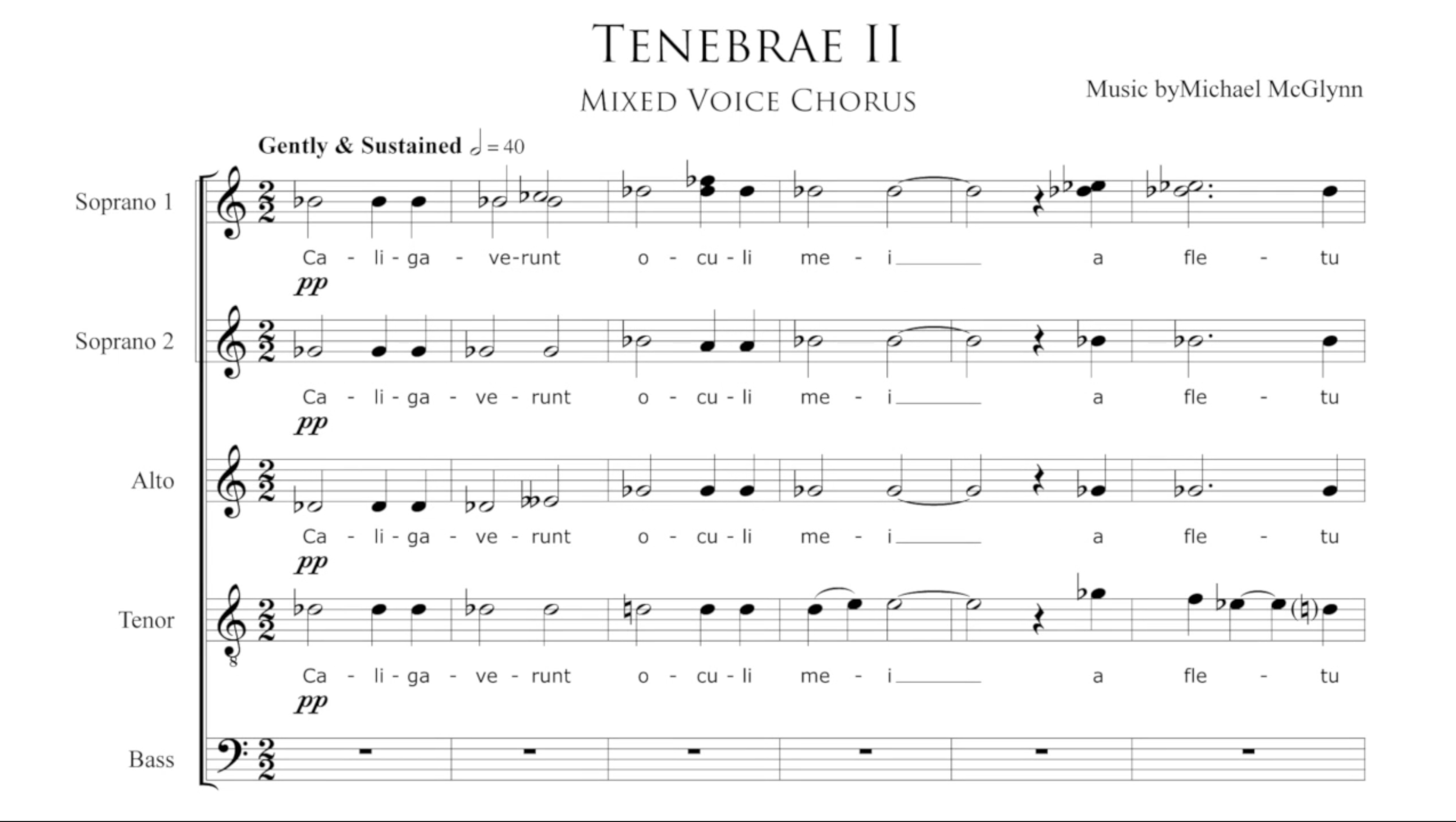
Dúlamán and Geantraí were originally one single song, but the necessity for another up-tempo number forced me to split it in half. Some of the material was way off the beaten track – O Viridissima Virga was a cascade of falling silvery voices and Tenebrae III sounded like it had fallen off the soundtrack of a video game (if they had existed in 1996…). For some reason the album worked very well. The 1995 release was very successful at home mainly on the back of massive over-exposure the previous year. Its mix of traditional Irish songs on the same disc as works by Hildegard of Bingen was oddly persuasive too.
By the time Omnis was hot off the presses it was a historical note, not a new album. I remember my mother saying to me after she first heard it that she couldn’t believe something so beautiful had been born out of so much turmoil. In retrospect I can’t either. The beauty of it is in the music rather than the performances I believe. I am still proud of the compositions on that record. “Dúlamán” has become a choral mega-hit all over the world thanks to the American ensemble Chanticleer who included it on their album Wondrous Love in 1997. The version of the album available today is an amalgamation of the 1995 release and the 1996 release, the latter recorded in the summer of 1996 in preparation for our departure from Riverdance. These are two completely different recordings, but I felt that I couldn’t justifiably continue to sell a record when most of the singers on it had left. I was young and stupid then.”

Omnis, 1995.
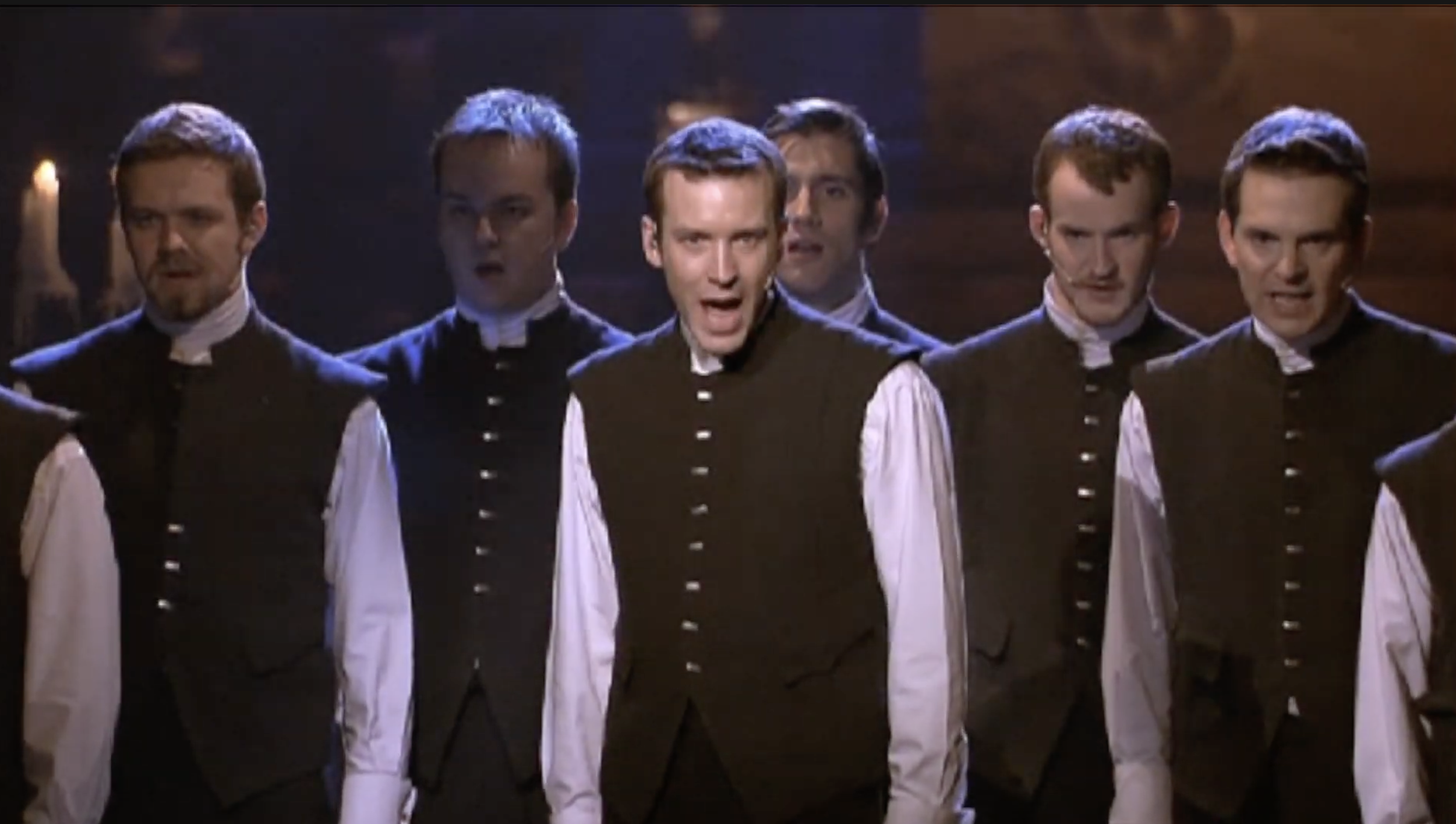
Anúna performed with the show in London, Belfast, Ireland and New York, but Michael decided not to seek to renew Anúna's contract, leaving in September 1996.
“At that stage Riverdance was very much becoming a single troupe, a single brand for want of a better description. I hadn’t set up ANÚNA to let it be absorbed into someones else’s creation and we parted with the producers amicably. But stepping off a moving train has consequences. Over the next year or so virtually all of the singers left ANÚNA to travel with the Show and I can’t blame them to be honest. A handful of them tried to remain as part of both for a short while, but life is not about going backwards. They eventually went their own ways and new singers joined us. So Anúna was reborn, as it would be many times over in subsequent decades, albeit tainted by a two edged celebrity status in Ireland, something I managed to shake off everywhere else except home.
In many ways ANÚNA itself is no different to Riverdance - a shifting collection of performers. ANÚNA has survived because of this, and Riverdance too although it is restricted in the material it can develop. No longer being part of the biggest show on the planet was a huge wrench for many of the singers. How do you go from being on stage in front of thousands of people back to the modest venues and smaller audiences that ANÚNA could offer?
For me personally it was very hard. I never had been interested in the glitzy part of the experience. Looking back I don’t really know why I remained with all of it as long as I did. I had been close friends with many of the group and those friendships had been important to me. All those relationships ended, and I suppose it made me very cautious when becoming personally involved with the singers for many years later, or at least until I was considerably more senior to the younger ones coming in to the ensemble. It was the first time I had to reboot the group, and it wouldn’t be the last. I discovered that the association with Riverdance had removed us from where we had been prior to 1994 in Ireland. And even today there is no definable place for the work of ANÚNA and myself on this island. Choral music has evolved into a reflection of the work of other nations, but hopefully that will not always be the case.
The influx of new singers in 1996 resulted in what is arguably one of our finest recordings Deep Dead Blue, but at the time it was pretty hard going for me. Deep Dead Blue was a conscious effort on my part to create a new definition, a new place for ANÚNA. It had become increasingly obvious that that would be outside of Ireland. Both records were licensed to Polygram, with the former achieving a top-five chart placing in the UK Classical Charts eventually in 1999. The original idea of the cover was to forcibly drag ANÚNA from the mainstream to the fringes of music where, I believed, it truly belonged. After a string of successful albums Deep Dead Blue pretty much sank without trace despite the eclectic nature of the music. I think at that point I came to accept what is a common thread in Irish artistic culture, that perceived success doesn’t necessarily bring good things to the table.”
Despite the lack of sales-success for the record it garnered some of the best reviews of ANÚNA’s career - Hot Press, Ireland’s version of Billboard wrote “…From the off the album emotionally engages the listener, solo voice or layered vocal, ancient Latin or English text, or modern lyric drawing one in to the very core of the music. That, I think, is what distinguishes Anúna's music from the rest - the tight connection to the heart and beyond. Mind you, it's not music to be flirted with; It demands a reciprocal commitment from the listener, which, if given, will not go unrewarded. This is beautiful, beautiful music and deserves the widest audience.”
Elvis Costello stated about the release “ Michael McGlynn is a remarkable composer and leader of the choral group Anúna. He has also been a good friend and a fine teacher in helping me overcome my reluctance to master musical notation. This allowed me to work more freely on The Juliet Letters and subsequent "written" compositions. Most of Michael's pieces draw on Irish early-Christian and pre-Christian texts as well as traditional airs and lyrical themes. These sources are recast in Michael's beautiful and startling music. It was therefore something of a departure for him to arrange "Deep Dead Blue" for the group. As Bill Frisell and I are yet to complete another composition, it is great to hear the transformation brought about by this choral rendition of our solitary song.” Michael views on the album are illuminating.
“Deep Dead Blue is full of oddities, but together the entirety of the record achieves a unity and a clarity. Besides the opening track, a personal favourite to sing, my favourite tracks on the record are “Island” and “Blackthorn”, both written simultaneously and both saying, in essence, the same thing. Our lives are immersed within a greater weave, and I think I have spent my whole life trying to interpret that connection in a way that I can understand and accept.”

Deep Dead Blue 1996. Cover design by Dynamo
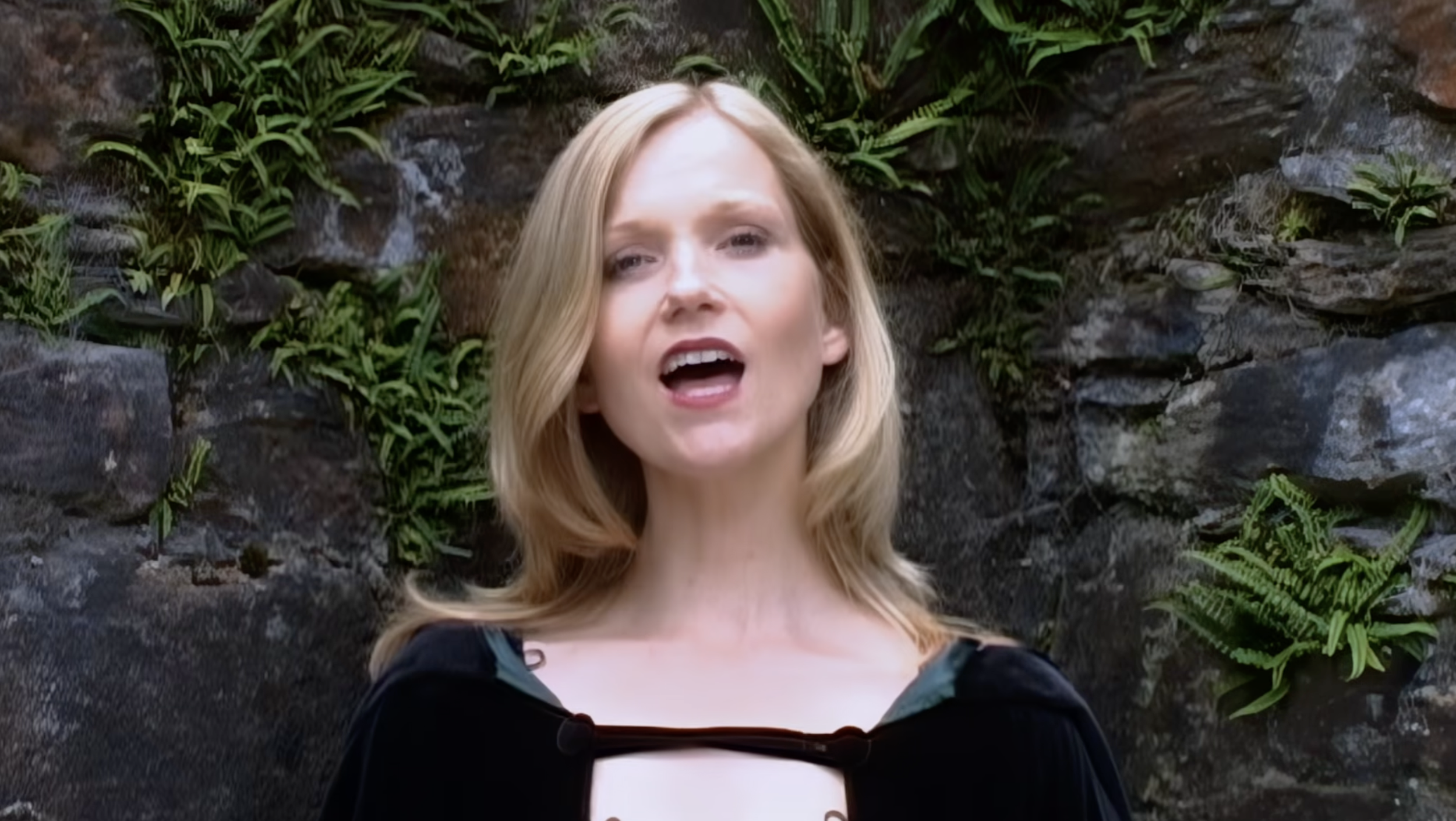
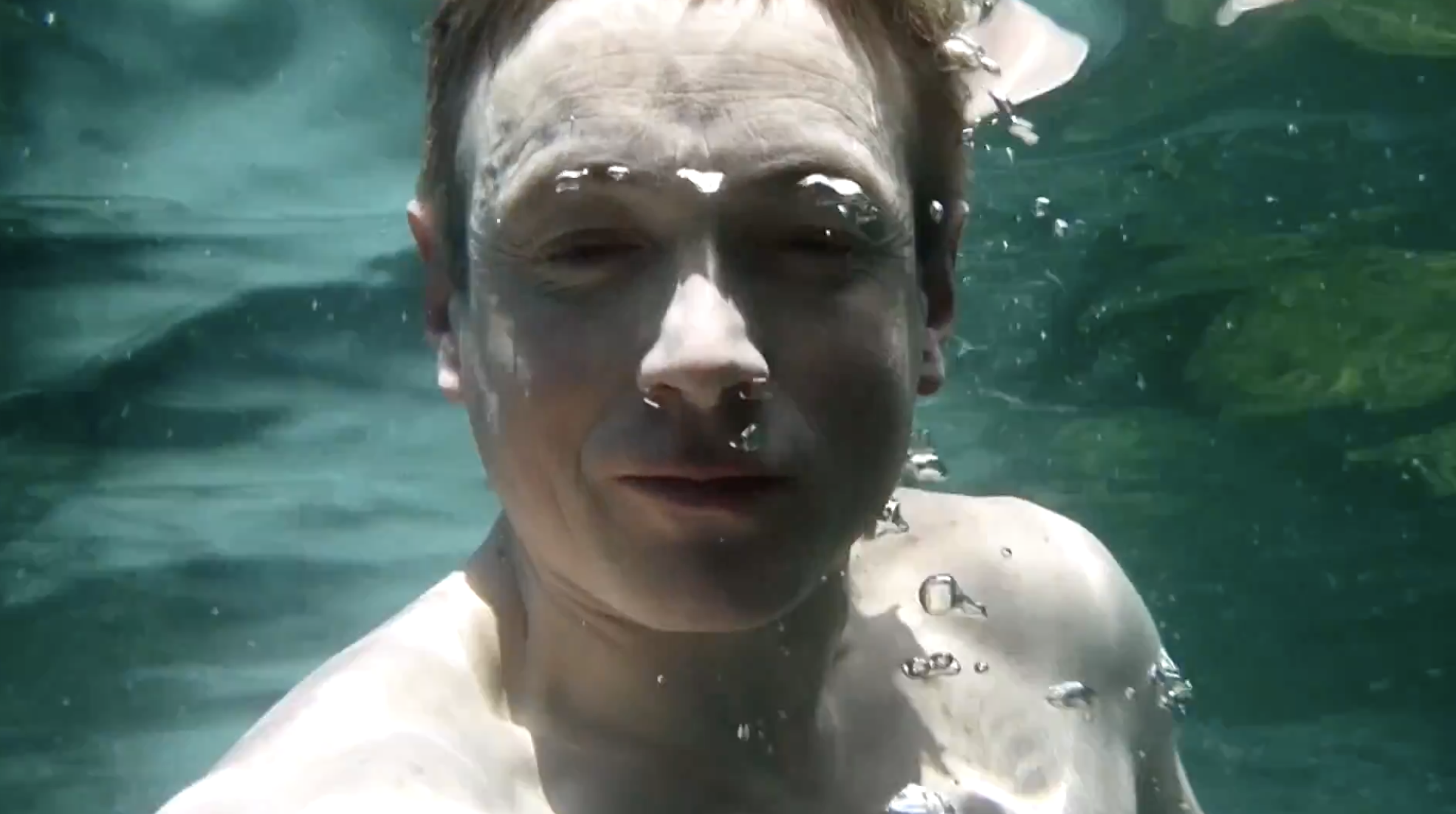
ANÚNA began to perform more and more outside of the country including tours of Sweden, Spain and France in 1996. While the choir had collaborated with many traditional and classical Irish artists, in Madrid that year they performed with renowned Basque performer Benito Lertxundi. A further connection to Eurovision was made when ANÚNA soprano Eimear Quinn won the 1996 Eurovision Song Contest in Oslo. To end an eventful year ANÚNA performed on "Later with Jools Holland" at the BBC in December.
"Later with Jools Holland" was one of the programmes I watched pretty much every week so it was a surreal experience to work on the show with Suede and Alexander O Neill among other luminaries. There were so many odd things happening around that time and this was just one more. When we came into studio no one had a clue what to do with us, but I was used to that. But it was the BBC, so they were brilliant, as they always have been for the numerous appearances we have had on TV. We looked odd and there were loads of us, and we didn’t use the standard sound setup but it went grand. I’m glad we did this and so many other bits of eclectic TV. It was pretty magical.”