
Deep Dead Blue (1996)
Released on CD and Cassette Danú 007
(Reissue Danú 020, 2004)
Released on Gimell/Polygram 462 822-2 (1999)
Available HERE and on all streaming services
UK Classical Specialist chart, No. 3 (August 1999)
Deep Dead Blue (3.00)
Elvis Costello and Bill Frisell
Nobilis Humilis (4.33)
Medieval Irish or Orkney Islands, arranged Michael McGlynn
Dicant Nunc (2.18)
Medieval Irish arranged Michael McGlynn
Blackthorn (3.17)
Michael McGlynn, traditional sourced text adaptation
Kyrie (2.11)
Michael McGlynn
Ther is no Ros (3.20)
Medieval English arr. Michael McGlynn
The Green Laurel (2.56)
Michael McGlynn, trad. text
Island (4.00)
Michael McGlynn
Sliabh Geal gCua (3.14)
Traditional, arranged Michael McGlynn
The Fisher King (3.52)
John McGlynn
Quem Queritis (3.52)
Medieval Irish arranged Michael McGlynn
The Sea (4.55)
Michael McGlynn
When I was in my Prime (3.10)
Traditional, arranged Michael McGlynn
This album is dedicated to the memory of Julia Hember
Produced by Michael McGlynn and Brian Masterson
Engineered by Brian Masterson
Assisted by Jonathan Ford and Conan Doyle
Cover Design 1996 edition - Dynamo Design
Cover photographs (1999 edition) Julia Hember
Recorded at Windmill Lane Studios, Soundscape Studios and Blackrock College 1996
2003 reissue Soundscape Studios recording and Mastering
“Deep Dead Blue” published by Plangent Visions Music Ltd. or Friz Tone Music.
Deep Dead Blue was recorded in the summer of 1996 in Blackrock College Chapel alongside the re-recording of Omnis. The recording was rushed and that last-minute methodology has become pretty standard in how I have come to work right up to sessions today. Long periods of composition were and are impossible. I run an office and do multiple jobs simultaneously, while also preparing performances and recordings, and at this period dealing with the fact that ten of my singers were pretty much permanently in Riverdance in London at the Hammersmith Odeon.
People, when they look at Anúna, often imagine an organisation with staff, resources, and infrastructural grant-aiding. None of that is the case. Over the last forty years it has usually just been me doing every aspect of the job, and over time gaining enough skills to do everything moderately well. I sometimes wonder what might have happened if things were otherwise. Would my compositions be better? In time I have realised that maybe that would not have been the case. Some people are just designed to do many things moderately well. Or at least that is my philosophy.
1996 was an interesting year. In March we travelled to New York to perform in the premiere of Riverdance - the Show at Radio City Music Hall for seven days. Before we departed, I had already told the production that ANÚNA and I would no longer be continuing after the summer of that year, despite them offering to make Anúna a permanent part of the troupe as a subset of the overall cast. Instead the singers who were part of ANÚNA simply stayed, and we were gradually forgotten. I suppose people must have thought I was mad to do that. The Show was about to explode in America and plans were underway to bring it across the world. But I had no interest in continuing. By the time we were making this record I already knew that the vast majority of the singers I had become close with over the preceding few years were going to stay with Riverdance. Many of them wanted to be part of both the group and the show. For a while, some of them tried to do both. But being part of a show where you are singing to thousands of people a night with standing ovations and with incredible international touring experiences, changes people fundamentally. Thankfully, I was not part of that. In life we cannot go backwards. We have to always move forward. So it was time to remake Anúna now, for the third time.
Right back in February 1995, at the Dublin premiere of Riverdance, I met Maureen O’Hara. I was discussing with her rumoured plans for the future that we had both heard. She said something that struck with me - once you dilute the original intent and power of something, soften the serendipity of that explosion, it will lose its power. The power of Riverdance was the moment it exploded. After that, it became as generic as any Broadway show or concept, albeit in our case tied into Irish culture. I realised that my creation of ANÚNA was something that had a greater value than tying it to something that was so tied into the year 1994.
Deep Dead Blue is a reaction to the turmoil and excitement of that time, a conscious response to the genrefication of ANÚNA into a “Celtic” asset, a commercial cliché. I was so lucky that the preceding seven years before Riverdance had allowed me to establish an ethos and I had time to explore so many different aspects of myself as a creative artist because I have never lost sight of where I had come from. Others have chosen to interpret aspects of my work, applying criteria based on limited knowledge, which has meant I have spent most of my time since Riverdance, particularly in Ireland, justifying my beliefs to people who cannot be bothered doing any research. But such is the way when you are involved in something that becomes world-renowned in a very short space of time.
The advantages with the Riverdance association were that people saw success, then interacted with me and realised that was not my priority. If you ask me what my priority was, and still remains, I cannot give you a clear answer. I can tell you it is a personal need. I can tell you it is about exploring my responses to the Earth itself and my culture and language. I can tell you it is a desire to collaborate with others with similar ideas to myself, which has always been a very difficult thing within the infrastructure in which ANÚNA existed up to 2022 when we quit Ireland. Maybe it is a combination of all these things. Either way, Deep Dead Blue was an effort to throw away the past and look forward, and I believe it succeeds very well in that.
The album was recorded in Blackrock College Chapel, the space where the first Anúna recording was made in 1993, but the atmosphere was completely different. The true ancestor of this record is Invocation. Invocation was brave and by this point I was very aware of how pigeonholed we had become through the Celtic revival that was sweeping through the music industry. So Deep Dead Blue can be seen as a sharp response to categorisation. Looking back now on the critical reviews they are quite incredible. Journalists kind of “got” us and our audience did see ANÚNA for what it was. But the general music infrastructure did not. We were just that choir from Riverdance, as far as they were concerned. And we have remained so, pretty much at home. Even now, one of the first things I am asked when I am interviewed in Ireland, which happens very infrequently, is about Riverdance even though we left it three decades ago and have had no association with it since then.
It is fitting that the album opens with the track “Deep Dead Blue”, because it is a very firm assertion of intent. It was a song introduced to me by Elvis Costello, written by himself and Bill Frisell, and it has a strong jazz flavour with a dark air of melancholy and an ambiguous lyric, very much characteristic of the work of Elvis. It pretty much reflected my own state of mind at the time, and it would be disingenuous of me to say I had not been traumatised by what had happened. I use the word trauma carefully, because it was positive and negative. I grew up very quickly, lost most of my colleagues and friends, and realised that I was much braver than I had thought. Knowledge was essential so I no longer could pretend I was young and naïve. I decided that this record should be completely different to what had gone before, but should still acknowledge the continuity of the ethos and the intent of the group established in the late 1980s. I wanted it to disorientate people who knew the earlier recordings, and to place us firmly in a contemporary musical sphere.
The fine artwork for the original album was developed by Dynamo Design, and the mandate for them was to create something contemporary with an Eastern flavour to it. It is very appropriate for this record, which is sonically cold, blue and silver. That minimalist feel is also part of how some of the music sits, especially in pieces like “Quem Queritis”, where Miriam Blennerhassett’s passionate solo is placed against a static soundscape picture. A three minute haiku you could say.
This recording also features an influx of new singers, and they brought their own unique aspects to the colour of the sound. Brand new into the group was Eimear Quinn, who had joined in 1995 and can be heard first on the 1995 recording of “Róisín Dubh”. She has a very strong and secure soprano voice, sonically pure and that influenced the choral texture. You can hear the colour of her voice on many of the textures, and you can hear that strength and assurance particularly in pieces such as “Nobilis Humilis” and the choral part of “Blackthorn”. Also new was the English soprano Lucy Champion. These were her first sessions. The colour of her voice and its inherent melancholy begin to be evident in the overall choral texture for the first time. Later, when I revisited the record, she took on a number of solos on the reissue. That was no reflection on the original soloists. It was more that her colour seemed to me to be much more appropriate to what I was trying to achieve originally on the record. It is a rare gift to be able go back and change something in this way, to revisit something created in haste.
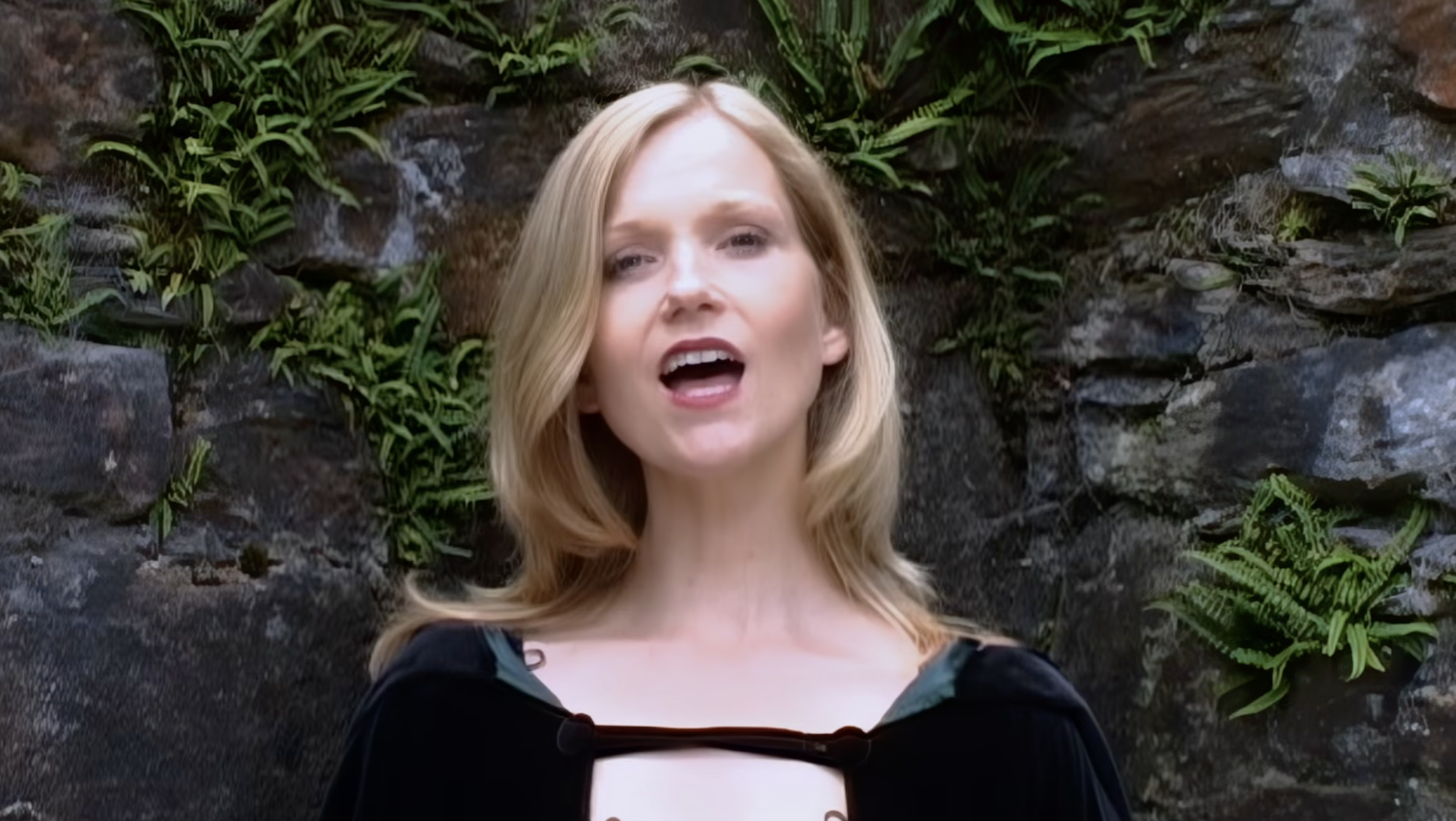
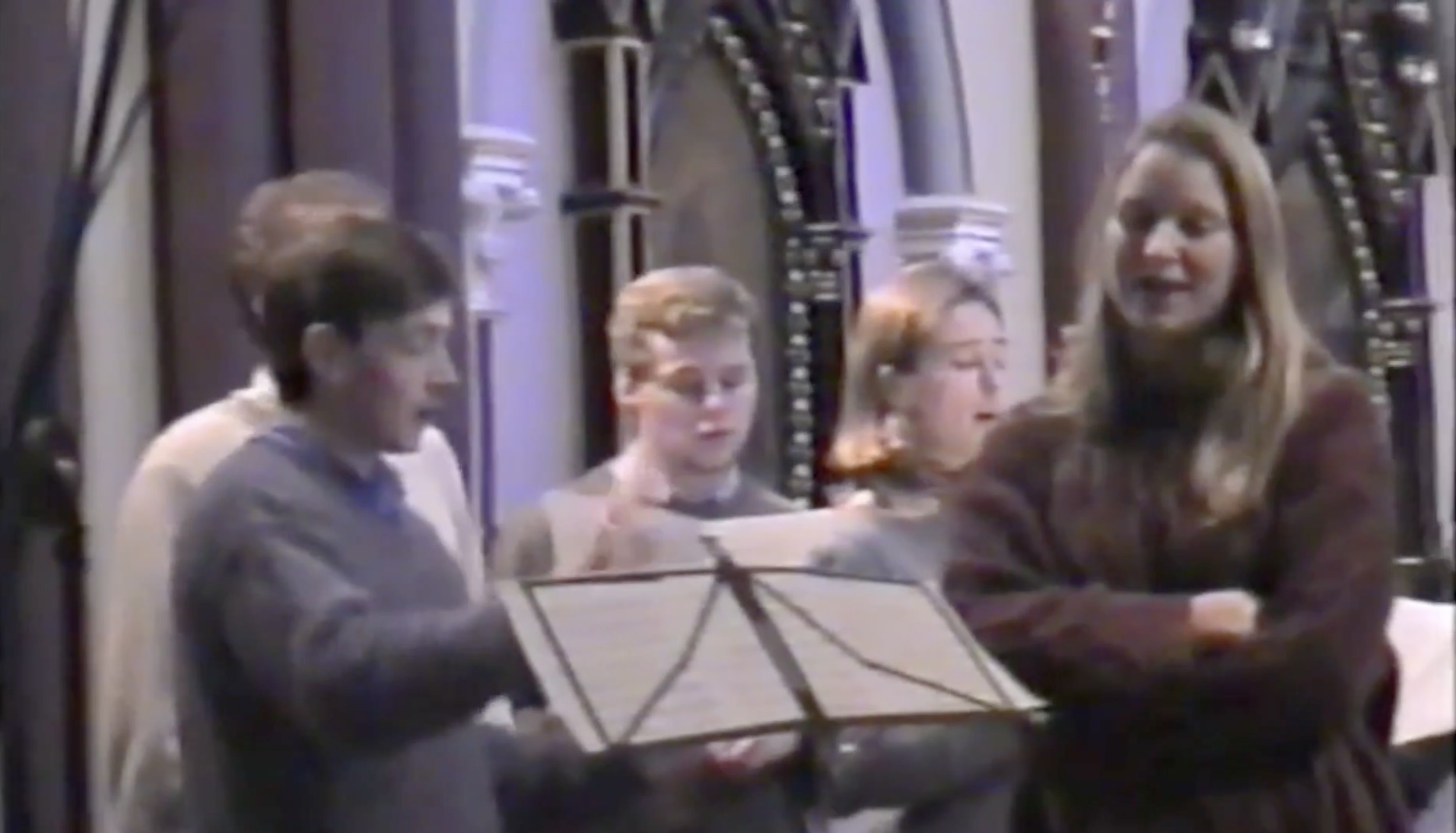
And then there is the actual business of recording. The recording process was very interesting on this album. At that point we knew what we could do in an acoustic space like Blackrock College Chapel. In some cases it meant we stood on the altar and sang into microphones, capturing exactly what we were singing. You can see that in the video for “The Green Laurel”, which was recorded during this session.
Recording in a church on a peaceful summer’s day only disturbed by the cooing of pigeons in the belfry to interrupt the reverie, has been one of the most wonderful fulfilling experiences for me. The idea of being able to create in a relaxed environment with no time constraint would be bliss for me. Feeding off the singers’s excitement when something new is presented to them, something that they can define as artists themselves because no one else has ever performed it. Something where you can affect their performance as the creator of the work in real time. There is nothing like it. Over the years, that has become harder and harder to achieve for me. And I have to say, I miss these times very much. I miss there being a resident choir in Ireland where we could rehearse, discuss and develop ideas together. Now when ANÚNA or any of the Collective ensembles come together, they are a myriad of different cultures and voices on time restrictions of flight schedules and studio time, often coming to unfamiliar places to record, simply due to technical limitations or scheduling limitations. The music is harder to write in this context, and yet their responses are the same as these early days when it was all new, and I try never to forget that. You have to remember, too, that this was the fourth album I had recorded in three years, with a fifth one the year after. This wasn’t because I was particularly inspired. It was more that circumstances allowed it, and I wonder today if I will ever get the chance to experience something like this again. If so, it will not be in a cool church space close to my home.
Now, some of the memories from this particular session are not romantic at all. They are ridiculous. Eimear chasing a fly around the church, being one. I remember Brian Masterson and I listening as it flew closer to the main microphone, and then away and her vain efforts to catch it. I think it got away. Recording of “The Sea” was almost farcical. The choral parts were sight-read in the space. Literally, I wrote them on the way to the church that morning, played the chords on the organ in the church, and they read them. The piece was then constructed from all the segments afterwards. I remember Brian watching me reconstruct all the “bits” in the edit, looking at me as if I was completely insane while we were recording, and then afterwards, when we were editing, the light bulb went on and he said, how do you hold all these things in your head at the same time? The answer is because I am making them and taking responsibility for them myself. So any mistakes made in the limited time we had recording were mine, not the choir’s.
There are pieces on this record that still feel like their own strange little worlds. “Nobilis Humilis” is probably the most trippy piece I have ever written. Running through it is an early Irish chant and the thirteenth-century hymn to Saint Magnus from the Orkney Islands. Wrapped up in the inspiration for the arrangement is the story of witches singing in two parts as they cast spells. And after that sombre contemporary opener, you get a piece that does not pander to anybody.
If there was one solo performance that stands out above all the others, it is Monica Donlon’s flawless “Kyrie”. We recorded it three times and each time she was utterly flawless, and identical. I have never been able to perform that work with the group since, because sometimes things are just perfect within themselves. When you hear something perfect, what is the point in trying to reproduce it just for the sake of it?
In 1999, the album was released by Polygram, and unfortunately they chose that exact moment to merge with Universal Records. The tantalising possibility that Anúna might be catapulted in a completely different direction ended rather abruptly. In 2003 I decided to go back in and remaster the album, and during the remastering I realised that some adjustments to solos had to be made.
I wrote “Island” for my own voice, but it is hard for some people to understand that I had no faith in my own singing. It had never been acknowledged as a good singing voice. I sang solos because others either could not sing what I wrote in the way I wanted it sung, or they had not learned it properly, or the solos were simply presented too late for singers to have time to absorb them. When I listened back to tracks with my own voice on them I would very often skip them. It took time before I realised my voice was fine. And it also took time before I realised that parts written initially for a man, such as on “Inisfree” on Invocation, or on this album, “Island”, should not have been recorded on record by a female vocalist. I replaced some other solo vocals as well with the voice of Lucy Champion. Again, that change was not about ranking singers. It was about colour, and intent, and the sound-world I thought the record was meant to have from the start.
It is sometimes hard for people today to realise how finite things were in the 1990s. The Internet was in its infancy so when this record was made and vanished without trace to all intents and purposes, it was dead and would never be heard again. It is only with the passing of time that I realise many people were deeply affected by this record on its release, one of them being the Japanese composer Yasunori Mitsuda who heard this album in the late 1990s and was so strongly influenced by it that he later asked us to sing on the soundtrack of the video game Xenoblade 2.
I know that Deep Dead Blue continues to be one of those records I can listen to from those early times. If I was to pick one track out that has most meaning to me, it is “Island”. It was my statement. And I have to point out the beauty of “The Fisher King”, composed by my brother John. It is interesting to see how his own journey as a writer mirrors my own in so many ways, and this fine song is a beautiful addition to an unusual, and dark, record.
Deep Dead Blue
“When both ANÚNA and Bill Frisell accepted my invitation to take part in the Meltdown Festival at the South Bank Centre, I could not imagine that it would one day result in this recording. Bill Frisell and I had decided to conclude our festival collaboration with a new composition, but as we were unable to compose together, I resolved to write words for one of Bill’s new themes. The tape, which I received from him, actually contained consecutive variations on the same material in E minor and E flat minor which, by chance, I imagined as one continuous piece. It also seemed to echo a vague theme, which I had failed to complete, entitled Deep Dead Blue. With Bill’s more inspiring music, I completed the following text. While it celebrates a life - long affection for melancholy, I trust it ends on an optimistic note.” Elvis Costello
Deep dead blue that I invite.
Bringing on disguise of night.
Turn the whole kaleidoscope
Deep dead blue.
Deep dead blue that nightly shades.
Most unlikely escapades
As the lights that frighten fade
Til the dawn drags into view
Beyond the deep dead blue.
Deep, dead blue, I’d rather stay
Far from the cruel coloured day.
Leave me in my monochrome,
Til I find a finer hue
Beyond the deep, dead blue.
Solo vocal Michael McGlynn
Nobilis Humilis
This piece from the Orkney Islands dates from the mid-thirteenth century, and was originally written in two parts. The Latin text describes St. Magnus of the Orkneys, who was martyred in the 13th century. The opening chant was written in honour of St. Patrick and comes from a fifteenth century source.
Superba namque colla gentilium virtute Sancti Spiritus humiliavit
For indeed he has laid low the proud necks of the gentiles, by the strength of the Holy Spirit.
Nobilis Humilis, Magne martyr stabilis
Serva carnis fragilis mole positos
Praeditus, caelitus, dono sancti spiritus.
Vivere temere summo caves opere
Carnis motus premere, studes penitus,
Ut carnis in carcere, regnet spiritus.
Turbidus, invidus, hostis Haco callidus,
Sternere, terere, tua sibi subdere
Te cupit et perdere, doli spiculo.
Iuncto fraudis federe, pacis osculo
O noble, humble, great and steadfast martyr,
Placed beneath the burden of frail flesh.
Well - favoured, heavenly, by the gift of the Holy Spirit
With the greatest effort you beware of living rashly.
You endeavour deep within yourself to suppress the motions of the flesh,
So that the spirit may reign in the prison of the flesh.
Hakon the turbulent, envious and cunning adversary
Desires to scatter what is yours, to crush it and subject it to himself,
And to destroy you by the barb of treachery,
By the compact of treason joined, by the kiss of peace.
Solo opening vocal Lucy Champion (2003 reissue), Caron Hannigan (1996 version)
Dicant Nunc
Very little medieval Irish music survives, but rarest of all are pieces in more than one part. Dicant Nunc dates from the middle of the 12th century, and is a rare example of medieval Irish music written in two or more parts.
Dicant nunc Iudaei quomodo milites custodientes
sepulchrum perdiderunt Regem ad lapidis positionem.
Quare non servabant petram iustitiae?
Aut sepultum reddant, aut resurgentem adorent nobiscum
dicentes Alleluia.
Yea, let the Jews say in how the soldiers keeping the
tomb stone in position lost the King.
How could they not keep the rock of justice?
Bury him in the tomb, or worship with us he who is risen
saying Alleluia.
Blackthorn
So many men think that I am theirs
when I sit with them, when I drink with them.
Nothing compares to all that was shared
between you and I, between you and I.
So many men reach for the highest branch
to find the bitter fruit, to find the bitter fruit.
Close within reach of the hand lies the sweetest berry
on the lowest branch, on the lowest branch.
Sneachta séidhte ‘s é dá shíor - chur ar sliabh Uí Fhloinn,
‘S tá mo ghrádh - sa mar bhláth na n - áirne ar an droighnéan donn.
Snow falls on the mountain of Sliabh Uí Fhloinn,
And my love is like sloe - blossom on the blackthorn.
Solo vocal Lucy Champion (2003 reissue), Méav Ní Mhaolchatha (1996 version)
Kyrie
Kyrie Eleison, Christe Eleison, Kyrie Eleison.
Lord have mercy, Christ have mercy, Lord have mercy.
Solo vocal Monica Donlon
Ther is no Ros
Ther is no ros of swich virtu, as is the ros that bear Jesu, Alleluia.
For in this ros contained was heaven and earth in little space, wonderful thing.
By that ros we may well see, ther be one God in persons three, of equal form.
Solo vocal Máire Lang & Michael McGlynn
The Green Laurel
I once had a sweetheart, but now I have none.
He’s gone and he’s left me in sorrow to weep and mourn.
He’s gone and left me for others to see.
I know that he’ll soon find another far better than me.
I wrote him a letter both loving and kind.
He wrote me an answer with sharp twisted lines,
Saying keep your love letters and I will keep mine.
You write to your love, and I’ll write to mine.
He passes my window both early and late.
The looks that he gives me would make my heart break.
The looks that he gives me a thousand would kill.
Whenever he wanders he’ll be my love still.
Green grows the laurel, soft falls the dew.
Hard was my heart when I parted from you.
In our next meeting I hope you’ll prove true,
And we’ll join the green laurel for the violet so blue.
Solo vocal Eimear Quinn
Island
On an island I long to be, gazing out upon the shining surface of the sea.
I hear the sound of the ocean wave on wave, crying you who have turned away from home.
On an island I long to live, sea - birds lament the coming of the winter wind.
I hear the endless sound of sea on shore, crying you who have turned away from home.
On an island I long to be, evening brings a whisper of the summer breeze.
I hear the sound of the ocean wave on wave, crying you who have turned away from home.
Ascnam tar tuinn topur ndílenn dochum nÉirenn
Deus caeli ac terrae, maris et fluminum
Deus solis ac lunae.
Deus super caelo et in caelo et sub caelo
Habet habitaculum erga caelum et terram et mare
Et omnia quae sunt in eis.
Non seperantur Pater et Filius et Spiritus Sanctus
To sail across the wild sea back to Ireland
God of heaven and earth, the sea and the rivers
God of the sun and the moon.
God above heaven and in heaven and under heaven
He dwells in heaven and earth and sea
And all that is in them.
The Father the Son and the Holy Spirit are not separate.
Solo vocal Michael McGlynn (2003 reissue), Eimear Quinn (1996 version)
Sliabh Geal gCua
Ó, a Shliabh Geal gCua na féile, is fada uait i gcéin mé,
I m’shuí cois cuain i m’aonar, go tréithlag faoi bhrón.
An tuile bhuí ar thaobh díom, ’dir mé ’gus tír mo chléibhe,
’Sa Shliabh Geal gCua na féile, nach géar é mo scéal!
Dá mbeinnse ’measc mo ghaolta i sceithín ghlas na scéimhfhear,
Nuair a scaipeann teas na gréine ó spéir gheal gan smál.
Nó dá mbeinnse ’n - siúd faoin réaltain, nuair a thiteann drúcht ar fhéar ann,
Ó, a Shliabh Geal gCua, nar dhéirc sin, dá mb’fhéidir é fháil.
’Sé mo léan nach bhfuair mé tógáil, le léann is mórchuid eolais,
I nGaelainn uasal cheolmhar ba sheolta mo bhéal.
Ó, threabhfainn cuairt thar sáile, is thabharfainn bua thar barr chughat,
Mar, a Shliabh Geal gCua, ba bhreá liom thú’ ardú fé réim.
O bright Sliabh Geal gCua of generosity, I am far from you in the distance,
I sit by the inlet alone, wearied with sorrow.
The yellow flood is at my side, between me and the land of my breast,
O bright Sliabh Geal gCua of generosity, how bitter is my story.
If I were among my people, in the little green shrubs of the gentle men,
When the heat of the sun spreads from a bright sky without blemish,
Or if I were there under the stars, when dew falls on the grass,
O Sliabh Geal gCua, would that not be an alms, if it were possible to obtain it.
It is my sorrow that I did not receive upbringing with learning and much knowledge;
In noble musical Irish my mouth would be fluent.
I would travel across the sea and bring you victory beyond all,
For, Sliabh Geal gCua, I would gladly raise you to ascendancy.
Solo vocal Róisín Dempsey
The Fisher King
Words and music by John McGlynn
I went down by the river side, that runs between the hazel’d halls,
And on an apple - blossomed hill, I slept beside the golden falls.
As I wandered far in sleep, the fisher king flashed blue on grey.
I heard a voice come from the deep, and call my name from far away.
I linger by the western sea, I hear the horseman riding past.
Young dreams I dreamt are gone from me, like summer whispers in the grass.
Rain won’t wash away the memories, and the wind won’t hide her perfume,
But it blows.
Solo vocal John McGlynn
Quem Queritis
The brief liturgical dialogue known as Quem queritis (“Whom do you seek?”) forms one of the earliest surviving examples of dramatic representation within the medieval Christian rite. Originating in Easter morning ceremonies of the 10th and 11th centuries, the trope presents a dialogue between the angel at the tomb and the women who come seeking the body of Christ. From these simple exchanges grew the wider European tradition of liturgical drama.
The version preserved in the so-called Dublin Play, a Middle English and Latin dramatic fragment associated with late medieval Dublin and generally dated to the 14th century, is of particular importance in the Irish context. It demonstrates the transmission of continental liturgical drama into the urban religious culture of medieval Ireland, while retaining the concise musical and textual structure characteristic of earlier monastic practice. The dialogue alternates between proclamation and response, culminating in the announcement of the Resurrection and the command to bear witness, a structural pattern that underlies many subsequent Passion and Easter plays.
Angel: Quem queritis ad sepulchrum, O Cristicole?
Marys: Ihesum Nazarenum crucifixum, O celicola.
Angel: Surrexit, non est hic, sicut dixit. Venite et videte locum ubi positus fuerat.
Marys: Alleluia, resurrexit Dominus. Alleluia resurrexit Dominus hodie. Resurrexit potens, fortis Cristus, filius Dei.
Angel: Et euntes dicite discipulis eius et Petro quia surrexit.
Marys: Eya, pergamus propere mandatum hoc perficere.
Solo vocal Miriam Blennerhassett
The Sea
White sea, cold wave, warm wind, white sky,
Wind high, warm sea, dark sky, wild wave.
Broad sea, white wave.
White sea, cold wave, warm wind, white sky,
Wind high, warm sea, dark sky, wild wave.
Solo vocal Lucy Champion (2003 reissue), Eimear Quinn (1996 version)
When I was in My Prime
When I Was in My Prime belongs to the song family commonly known as The Seeds of Love (Roud 3). Texts related to this group are recorded in print in the late eighteenth century, and the melody was notated from oral tradition by Cecil Sharp in Somerset in 1903. The version sung by Pentangle in 1970, and adapted by ANÚNA, represents a shortened descendant of this broader tradition.
When I was in my prime,
I flourished like a vine.
There came along a false young man
that stole the heart of mine.
The gardener standing by
three offers he made to me,
The pink, the violet and red rose
which I refused all three.
The pink’s no flower at all,
for it fades away too soon,
and the violet is too pale a hue.
I think I’ll wait til June.
In June the red rose blooms.
That’s not the flower for me,
for then I’ll pluck the red rose off
and plant a willow tree.
And the willow tree shall weep,
And the willow tree shall whine.
I wish I was in the young man’s arms
that stole the heart of mine.
If I’m spared for one year more
and God should grant me grace,
I’ll weep a bowl of crystal tears
to wash his deceitful face
Solo vocal Méav Ní Mhaolchatha
ANÚNA
Musical Director, Michael McGlynn
John McGlynn
Lucy Champion
Eimear Quinn
Miriam Blennerhassett
Monica Donlon
Méav Ní Mhaolchatha
Roisín Dempsey
Máire Lang
Garrath Patterson
Emer Lang
Paul Byrne
Jacqui Mahon
Stephen Kenny
Andrew Redmond
Eunan McDonald
Jeffrey Ledwidge
Peter Harney
David Clarke
Stuart Kinsella
Sarah Noon
Caron Hannigan
Mairéad Ní Fhaoláin
Clionadh McDonough
Paddy Connolly
Tara O’Beirne
Ciarán Brady
Rachel Talbot
Dearbhla Walsh
John McGlynn - Guitar on “The Fisher King”]
Bill Dowdall - Flute and Alto Flute on “The Sea”
Anne-Marie O’Farrell - Irish Harp on “Ther is no Ros”, “Nobilis Humilis”, “Island” and “Blackthorn”
Lloyd Byrne - Percussion on Dicant Nunc