
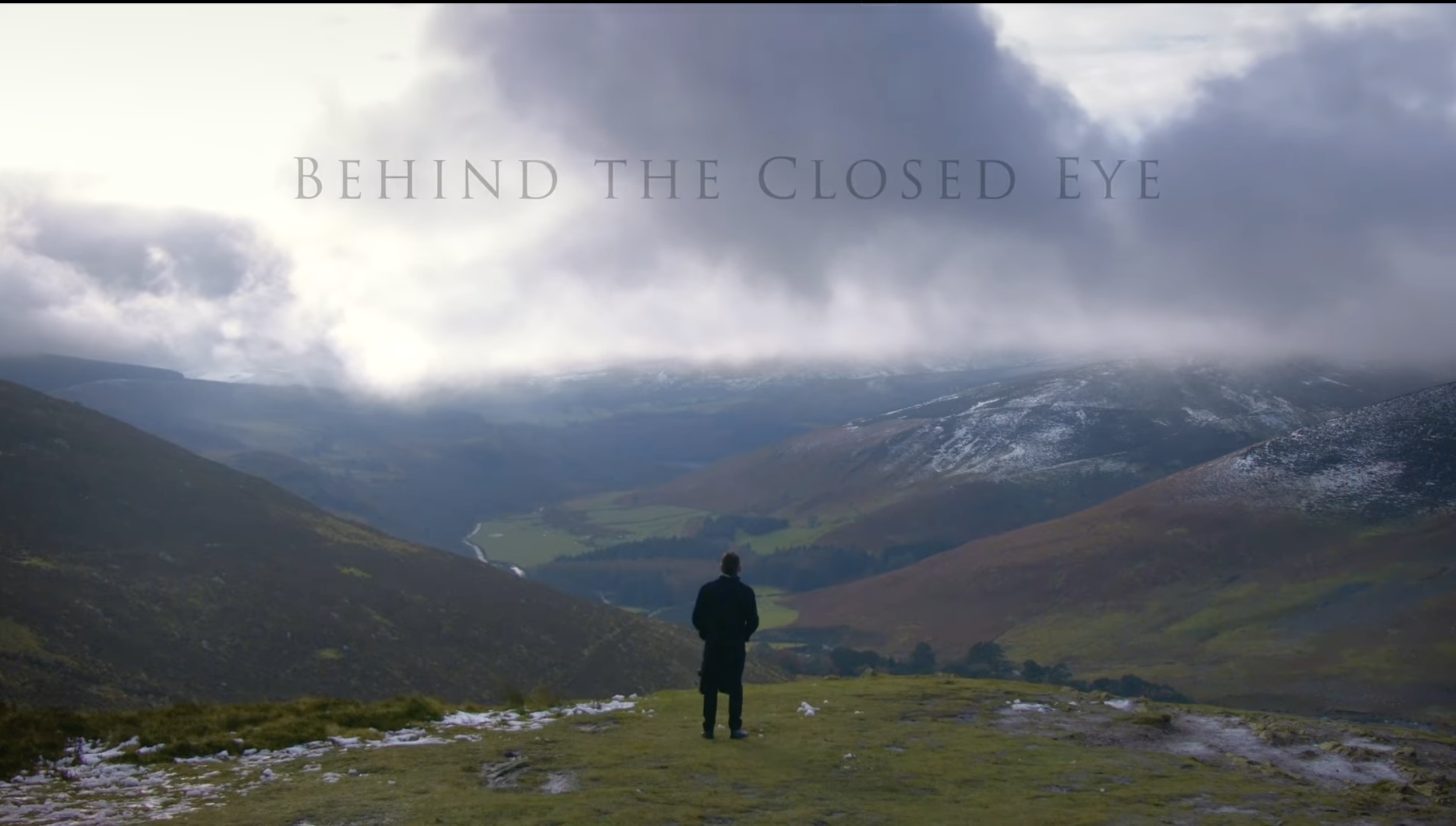
Behind the Closed Eye (1997)
Released Danú 009 (1997)
New version Danú 017 (2003)
Available HERE and on all streaming services
Japan Release (Japan only) Vivo 268
Design Brendan Donlon
Design and Image Michael McGlynn
August [1.51]
Aisling [3.16]
The Great Wood [3.12]
From Nowhere to Nowhere [2.33]
Annaghdown [3.18]
Ceann Dubh Dílis [2.05]
Ave Maria [2.53]
Gathering Mushrooms [3.00]
Behind the Closed Eye [3.16]
Midnight [4.20]
The Coming of Winter [2.43]
Where All Roses Go [3.53]
1901 [5.28]
Produced by Michael McGlynn and Brian Masterson
Engineered by Brian Masterson
Assisted by Kieran Lynch, Jonathan Ford, Ciarán Cahill, Conal Markey
Recorded in the Ulster Hall, Belfast and Windmill Lane Studios, Dublin, May to September 1997 and in August 2002 (Danú 017)
All tracks written, orchestrated and arranged by Michael McGlynn.
Behind the Closed Eye follows Deep Dead Blue by less than a year. The response to Deep Dead Blue had been so muted that I didn’t intend to record any more albums for a long time. I thought it was a beautiful record that we had made, with some fine songs and excellent performances, and I was disappointed by its failure.
Then, out of nowhere, came the possibility of recording an album with the Ulster Orchestra, Northern Ireland’s principal orchestra. Lucy Champion was orchestral manager there and had joined ANÚNA in 1996. She connects with my classical instincts and training, and possesses the same great love for the British choral tradition. So it is not particularly surprising to hear tones and pastoral hues that superficially seem more closely connected to Vaughan Williams than Seoirse Bodley on this album.
Unfortunately the timescale for composition was very short, and most of the record was written within six weeks, which explains why I reached backwards into older pieces and inspirations for some of the pieces on this album. “The Coming of Winter” is based on one of my first pieces, “Rince” from 1985, written when I was just twenty-one. And I think it is a banger. The energy of the playing on this is just on the edge of out of control, and that is contrasted with the evocative central section. The orchestral accompaniment for “Annaghdown” was originally a piano part for a setting of the traditional song “Anach Cuan” from 1988, a setting of the poem by Antaine Ó Raifteirí (1779–1835). In my opinion, this is one of the most important poems in our tradition concerning a multiple drowning on Lough Corrib in the eighteenth century. The horror of the event is written in the plainest and most direct of prose, the dead listed as their bodies lay by the water’s edge. The poet is consumed by a level of despair that exists rarely in Irish poetry. When I set this originally I felt that the piano part was far to disconnected from the narrative, so for the album I took fragments of the text and rewrote the melodic line in sympathy with the melismatic accompaniment.
“Ave Maria” and “The Great Wood” both contain elements of the Celtic Mass from 1991, with the former only slightly augmented from the original setting. “From Nowhere to Nowhere” was composed in 1996 and is a sean-nós inspired meditation for solo saxophone, commissioned by the Derry saxophonist Gerard McChrystal and played on this album by Kenneth Edge. This elegiac piece was essential I think, counterpointing the dense textures of the the rest of the album. We didn’t use a full orchestra for the recording - strings, woodwind and harp with some percussion, which I felt was more appropriate than a full symphony orchestra, as it had to balance with the unaccompanied choral pieces.
The recording took place in the Ulster Hall in Belfast on May 27th 1997 at a time when the city was still marked by the Troubles. The upper windows of the Hall had been blown out in an explosion and had not yet been replaced. Chinook helicopters passed overhead during the session and we had to stop repeatedly. The ceasefire had broken down in 1996, and a year later the situation was improving by fragile. I had travelled over the Border frequently in the early 1990s with ANÚNA. Only two and a half hours from my front door, Belfast felt like another world, with armed soldiers on the streets and the constant threat of violence. Anúna was one of the very few groups that travelled from the Republic during the height of the Troubles at a time when Irish performers were receiving death threats. That may explain why we have always had a particularly close relationship with our audience there. In contrast to how we were viewed in the Republic of Ireland, maybe there was a greater need for ANÚNA? I do know that when we performed there it was in Protestant and Catholic churches and cathedrals, and I would like to think that we has some small value to people that saw us in such a dark time. I suppose the pastoral atmosphere of Behind the Closed Eye was an unconscious response to the time and place it was created.
The album was directed from the orchestra by Lesley Hatfield. She went meticulously through the scores with me in advance and discussed the intent of each piece. Some of the textures, despite their apparent simplicity, were difficult to achieve. We have to remember that I had no training in writing for or working with an orchestra, but I was no novice. Engaging with her was stimulating and brought huge insights to me. We decided there would be no conductor and she would direct from the Leader position. This was partly because I wanted someone like myself, part of the fabric of the ensemble, to guide the sessions and partly because my view was that conductors are another layer of interpretation that were not really helpful in a session where all of the music was new and running around in my head alongside what the choral textures were going to sound like. Big, romantic gestures, however beautiful, would conflict with what I wanted as the desired outcome.
The original intention had been to record choir and orchestra together. That proved impractical for technical reasons and, to be honest, I was not confident that the choir would perform as securely with a professional orchestra in that environment as they would in the more relaxed atmosphere of a studio in Dublin. Only two pieces were recorded intact on 27 May. One was “Where All Roses Go”. I had to stand far from the orchestra, and Lesley effectively had to lip-read me because of the separation between us. It was completed in two takes. “Ave Maria” was also recorded live. Miriam Blennerhassett stood with the orchestra, and sang beautifully with her dark mezzo-soprano. And I noted that there was a degree of impatience from some players. I have no time for this when a singer is involved. Singers are subject to their humanity in a way that no orchestral player is. We are the instrument and where we have to go to create a sound at all is alien to most instrumentalists. Despite the atmosphere and some muttered commentary, Miriam delivered one of the most passionate performances of anything I have written.
Brian Masterson sat on a small table facing the main stage of the Ulster Hall. The Hall had a boomy resonance, amplified by the hollow wooden stage, which created some problems in post-production. His approach to recording the orchestra was the same as with Anúna - close microphones that preserve theimperfect, and thus capturing the humanity of the players. There were extraordinary and difficult moments in the session. The opening of “1901” took many, many takes. When you listen to it, it appears simple and transparent, but the strings struggled with tuning repeatedly. Each time they finished I stopped and said that what I was hearing was not what was written on the page, rather bluntly. Apparently that is just not acceptable, but they got there in the end. Lesley remained patient and completely committed. Her playing on “Aisling” is sublime and it ended up being one of the highlights of the recording. I have to single out the harp playing of Lucy Wakeford who captured “Gathering Mushrooms” exactly the way I wanted. Harpists are awesome…
The harmonic vocabulary across the album is unified despite the speed of composition. Leitmotivic cells recur. The falling lines of the opening of “Midnight” align with the string opening of “Where All Roses Go”. The harmonic progressions of “Gathering Mushrooms” connect with “The Great Wood”. “The Coming of Winter”, in its original 1985 form, established an archaic tonal field that continues throughout - open fifths, homophonic orchestral motion, a symphonic choral sonority.
At this time I was absorbed in the work of Francis Ledwidge (1887–1917). My primary degree in College had been English Literature and I had managed to avoid his beautiful poetry throughout my entire degree. He was killed in 1917 by a bomb while serving in the British Army. Many young men went to fight for Britain as part of an effort to further the Nationalist cause at home in Ireland, and despite his overt nationalism, he had been somewhat consigned to obscurity. “August”, “Midnight” and “Where All Roses Go” were all written by Ledwidge and coloured the entire ethos of the album, so it is effectively inspired by his poetry. His approaching death is written into the poetry, and it takes repeated reading to register. “August”, which opens the record, has elements that connect it to the work of Arthur Rimbaud (1854–1891) and his stunning “Aube” - the idea of the dawn/August as an elusive and powerful force. What sounds like a simple evocation of late summer is, on closer listening, a meditation on transience. “August” opens as a declaration of colour. Its harmonic richness is unlike earlier Anúna recordings, brief yet containing the entire emotional landscape of the record.
The title track, “Behind the Closed Eye”, is structurally unsettling for the listener-a vocalise, a meditation on nostalgia, rich and expressive, with Kenneth Edge’s beautiful saxophone suspended within the a text by Sedulius Scottus. The colour of an Irish summer day.
Similar to “Wind on Sea” on Invocation, it creates an expansive image in which we as human beings are insignificant, yet intrinsically part of the landscape. Our creative effort moulds and bends elemental forces in ways we are often unaware - an act of creation.
And that brings us to “Where All Roses Go”. I had first seen Jeff Buckley on a late night BBC arts programme a few weeks previously, where I heard him sing “Grace” live, and it affected me so deeply that I did something I rarely do - went out the next day and after much searching, bought his debut album. As fate sometimes allows, a few weeks later I found myself on stage with him at Elvis Costello’s Meltdown Festival in 1995, completely unexpectedly. I was there to sing a few solo lute songs with Fretwork and he was going to attempt Purcell’s “When I am Laid in Earth” at pitch. It was one of those concerts where everything could go wrong, but everything goes right. Before we went on stage I saw him hanging around the green room, looking a little lost, so I told him how much his music had affected me. Inevitably we ended up in the women’s toilets of the Queen Elizabeth Hall having a singing competition, which he invariably won. That night he dedicated “Grace” to me in an unexpected solo encore from the stage. Afterwards a wild night exploring the dark wonders of mid-1990s London, talking about art, life and music passed into one of those places in my memory that I still treasure today. A unique individual shining brightly like a falling star. Two days after the session I heard he had died.
None of the choral pieces had been recorded at that stage, and the entire process took on a different meaning. Like Ledwidge, Jeff was my age and his death changed the entire colour of the album, with “Where All Roses Go” now being a prophetic statement for a lost rose. Sometimes artistic creation makes no sense. And Behind the Closed Eye became a quiet memorial, a meditation. In recent years the song has been reinterpreted beautifully by Clare Stewart and Apollo5 as an unaccompanied song, bringing this forgotten piece to a new audience. I think it is the finest thing I have written, and alongside its companion “Midnight”, something I am very proud of.
“From Nowhere to Nowhere” still unsettles me. It was strongly influenced by Debussy’s “Syrinx”, a piece I have never actually liked, but one that awakened the spark that produced this atmospheric unaccompanied work, now performed all over the world by saxophonists thanks to its commissioner and advocate Gerard McChrystal, to whom I am deeply grateful. During the Great Famine the British government would not give direct charity to the starving. Instead they instituted public works. Dying and sick people were required to build roads and walls simply in order to receive sustenance. Many of these roads were built without destination, without purpose. They went from nowhere to nowhere. When you walk certain roads in the West of Ireland, you are walking through that a landscape that is extraordinarily beautiful, but conceals tragedy and the horrors of disease and starvation. Ireland was exporting food while its people starved. As a nation we have never recovered from this, and composing this was not detached in a way that I sometimes need to be to write. This is one of my few pieces that I've written that upsets me.
“Ceann Dubh Dílis” exists for the same reason I have often placed certain pieces slightly outside an album’s main intent-to provide release. It became a viral success in 2025 for the Russian vocal group Spokanki, whose unique interpretation gave it a new lease of life. This piece connects it specifically to a body of work that you will find throughout ANÚNA’s history, settings of Irish language poetry uniquely created as an effort to define an Irish choral sound. Its success thirty years after its composition mirrors much of that of my work in this area. Sometimes things just take a long time to find the right moment
The album sits comfortably within the ethos of Anúna’s work and mine. The orchestra becomes another voice, part of a texture permeating a world of muted colours-greens and blues, darkness concealed beneath shimmering strings and gentle voices.
When it was released, what surprised me most was how successful it was. It sold five or six thousand units relatively quickly. It did not register at home and resulted in no symphonic commissions for me, but it was noticed outside of Ireland. Behind the Closed Eye was taken as part our deal with Gimell/Polygram the following year. It remains a great regret that the album was never released directly under that arrangement due to the sale of Polygram to Seagram in 1998. But maybe this is its time. I am very proud of this record. For all its flaws and rough edges, it is one I return to often.
AUGUST
Solo: Michael McGlynn
She'll come at dusky first of day,
White over yellow harvest's song.
Upon her dewy rainbow way
She shall be beautiful and strong.
The lidless eye of noon shall spray
Tan on her ankles in the hay,
Shall kiss her brown the whole day long.
I'll know her in the windows, tall
Above the crickets of the hay.
I'll know her when her odd eyes fall,
One May-blue one November-grey.
I'll watch her down the red barn wall
Take down her rusty scythe, and call,
And I will follow her away.
AISLING
Solo violin Lesley Hatfield
Harp Lucy Wakeford
An Aisling was a dream or vision that came to the poet while he slept, usually in the form of a beautiful woman.
“Aisling” was commissioned by The Ulster Orchestra, aided by the Arts Council of Northern Ireland.
THE GREAT WOOD
Solo: Monica Donlon
An evocation of natural, primordial energy blended with the the text of the Gloria from the Mass.
Qui tollis peccata mundi, Miserere nobis. Deus Pater omnipotens, Domine Fili unigenite Jesu Christe. Laudamus te, benedicimus te, adoramus te, glorificamus te. Quoniam tu solus sanctus, Tu solus altissimus Jesu Christe.
You who take away the sins of the world, have mercy on us. Almighty God and Father, Jesus Christ the only son of God. We worship you, we give thanks to you, we venerate you, we glorify you. For you alone are the holy one, you alone are the most high Jesus Christ.
FROM NOWHERE TO NOWHERE
Kenneth Edge, saxophone.
“From Nowhere to Nowhere” was commissioned by Gerard McChrystal, grant aided by the Arts Council of Ireland.
ANNAGHDOWN
Soloists: Róisín Dempsey & Méav Ní Mhaolchatha (1997) Lucy Champion & Lynn Hilary (2003)
Annaghdown (Eanach Dhúin) is a small parish on the east side of Lough Corrib, north of Galway City. A group of villagers were attempting to cross Lough Corrib when tragically the boat sank very close to shore. Of the thirty passengers, eleven men and eight women drowned. This song contains the poem written by Antoine Ó Raifteirí (c.1784-1835) as a memorial to those who died. The entire poem is printed below.
Má fhaighimse sláinte is fada a bheas trácht ar an méid a báthadh as Anach Cuan. 'S mo thrua amárach gach athair is máthair, bean is páiste atá ag sileadh súl. A Rí na nGrásta a cheap Neamh is Páras, nár bheag an t-ádhbh dhinn beirt nó triúr, ach lá chomh breá leis gan gaoth gan báisteach, lán an bháid acu scuabadh ar siúl.
Nár mhór an t-ionadh os comhair na ndaoine a bhfeiscint sínte ar chúl a gcinn, screadadh is caoineadh ag scanradh daoine, gruaig á cíoradh is an chreach á roinn. Bhí buachaillí óga ann i dteacht an fhómhair, sínte ar chróchar is tugtha go cill, is gurbh é gléas a bpósta a bhí mar thurraimh, is a Dhia na Glóire, nár mhór an feall.
Loscadh sléibhte agus scalladh cléibhe ar an áit ar éagadar is milleán crua, mar is iomaí créatúr a d'fhág sé ag géargol, ag sileadh is ag éagaoin gach maidin Luain. Ní diabhal eolais a chuir i dtreoir iad ach mí-ádh mór a bhí sa gCaisleán Nua, is é críochnú an amhráin gur báthadh mórán is d'fhág ábhar dóil is brón ag Anach Cuan.
If my health holds I will long be speaking of those who drowned at Anach Cuan. My sorrow tomorrow for every father and mother, woman and child that sheds tears. O King of Graces who made Heaven and Paradise, was it not little to take two or three, but on a day so fine without wind or rain, a full boat of them swept away.
What a great shock before the people there to see them laid out on their backs, screaming and keening frightening everyone, hair being torn and the loss being shared. Young boys were there at the coming of harvest, laid on biers and carried to the churchyard, and it was their wedding clothes that served as shrouds, O God of Glory, what a great betrayal.
May the mountains burn and the chests scald on the place where they perished, bitter reproach, for many a creature it left in sharp weeping, crying and lamenting every Monday morning. It was no fault of navigation that steered them wrong but the great misfortune that was in the Caisleán Nua, and the end of the song is that many were drowned and left grief and sorrow at Anach Cuan.
CEANN DUBH DÍLIS
A traditional text dating from the 18th century.
Percussion Noel Eccles
A chinn duibh dhílis dhílis dhílis, cuir do lámh mhín gheal tharam anall. A bhéilín meala 'bhfuil boladh na tíme air, is duine gan chroí nach dtabharfadh duit grá. Tá cailíní ar an mbaile seo ar buile 's ar buaireamh, ag tarraingt a ngruaige 's á ligean le gaoith, ar mo shonsa, an scafaire is fearr ins na tuatha, ach do thréigfinn an méid sin ar rún díl mo chroí. Is cuir do cheann dílis dílis dílis, cuir do cheann dílis tharam anall. A bhéilín meala 'bhfuil boladh na tíme air, is duine gan chroí nach dtabharfadh duit grá.
My sweet dark-haired love, sweet, sweet, put your soft pale hand around me now. Little mouth of honey with the smell of thyme, it is a heartless man that would not love you. The girls of this town are wild and troubled, pulling their hair and letting it blow in the wind, for me, the finest man in the countryside, but I would leave them all for my heart's dear love. Lay your sweet head, sweet, sweet, lay your sweet head over me. Little mouth of honey with the smell of thyme, it is a heartless man that would not love you.
AVE MARIA
Solo: Miriam Blennerhassett
Ave Maria, gratia plena, Dominus tecum, benedicta tu in mulieribus et benedictus fructus ventris tui Jesus. Sancta Maria Mater Dei, ora pro nobis peccatoribus, nunc et in hora mortis nostrae. Amen.
Hail Mary, full of grace, the Lord is with you. Blessed are you among all women and blessed is Jesus, the fruit of your womb. Holy Mary, God's mother, pray for us sinners, now and at the hour of our death. Amen.
GATHERING MUSHROOMS
Solo: Michael McGlynn
Rising early out of bed across the field I steered, oh, when I a fair woman spied, a pretty young maiden appeared, oh. Her health was fair, I do declare, she had neither a hat nor feather on. She stooped so low, gave me to know, 'twas mushrooms she was gathering, oh.
"Where are you going?" said I, my dear, "why are you up so early, oh? I've seen you on the dewy grass before the sun shone early, oh." Quite modestly she answered me and she gave her head one fetch up, and she said "I am gathering mushrooms for to make my Mammy ketchup, oh."
Her parting breast on mine she pressed, her heart was light as feather, oh. Her lips on mine did gently join and we both sat down together, oh.
BEHIND THE CLOSED EYE
The text is by the Irish writer Sedulius Scottus and dates from the 9th century.
Gaudeant caeli, mare, cuncta terra
Rejoice you heaven, sea and all of the land
Personet patrem genitumque Christum spiritum sanctum:
Sing now of the Father, Christ begotten and the Holy Spirit.
MIDNIGHT
Soloists: Méav Ní Mhaolchatha and Lynn Hilary
Text by Francis Ledwidge.
Then in the lull of midnight, gentle arms
Lifted him slowly down the slopes of death,
Lest he should hear again the mad alarms
Of battle, dying moans, and painful breath.
And where the earth was soft for flowers we made
A grave for him that he might better rest,
So, Spring shall come and leave it sweet arrayed,
And there the lark shall turn her dewy nest.
THE COMING OF WINTER
Text 9th century. The entire poem is printed below.
Gáeth ard úar, ísel grían, gair a rith, ruirthech rían; roruad rath, ro cleth cruth, ro gab gnáth giugrann guth. Ro gab úar etti én, aigre ré: é mo scél.
Wind high and cold, sun low, short its course, the sea runs strong; the bracken has reddened, its shape hidden, the barnacle goose's cry has grown familiar. Cold has taken hold of the birds' wings, icy season: this is my news.
WHERE ALL ROSES GO
Solo: Michael McGlynn
The text is adapted from Francis Ledwidge's poems "Lament for Thomas MacDonough" and "June".
He shall not hear the bittern cry
In the wild sky, where he is lain,
Nor voices of the sweeter birds
Above the wailing of the rain.
Nor shall he know when loud March blows
Thro' slanting snows her fanfare shrill,
Blowing to flame the golden cup
Of many an upset daffodil.
But when the Dark Cow leaves the moor,
And pastures poor with greedy weeds,
Perhaps he'll hear her low at morn
Lifting her horn in pleasant meads.
Soon the swallows will be flying south, The wind wheel north to gather in the snow, Even the roses split on youth's red mouth Will soon blow down the road all roses go.
Dedicated to Jeff Buckley (1967-1997)
1901
Solo: Deirdre Gilsenan (1997), Lucy Champion (2003)
ANÚNA
Director: Michael McGlynn
John McGlynn
Miriam Blennerhassett
Lucy Champion
Monica Donlon
Lynn Hilary
Méav Ní Mhaolchatha
Garrath Patterson
Stephen Kenny
John McKeown
Paul Byrne
Eunan McDonald
Cathal Clinch
Andrew Redmond
Jeffrey Ledwidge
Mark O’Sullivan
Simon Morgan
Maeve Morris
Róisín Dempsey
Róisín O’Reilly
Joanna Fagan
Julie Feeney
Emer Lang
Jacqui Mahon
Edel Harrington
Sarah O’Kennedy
Audrey Phelan
Barry Finn
Kira Deegan
Deirdre Gilsenan
Saxophone: Kenneth Edge
The Ulster Orchestra
Lesley Hatfield Director/Soloist
Harp
Lucy Wakeford
First Violins
Clare Hoffman
Philip Clegg
Philip Davies
Jonathan Griffin
Chad Koelmeyer
Gillian Leeming
Ottoline Maas
Alexandra MacKenzie
Second Violins
Michael Alexander
Helen Wakelam
Bernadette McBrierty
Patricia Fenton
Jennifer Lomas
Guera Maunder
John McKernan
Margaret Wilson
Violas
Ashley Mason
Ruth Bebb
Elizabeth Dean
Richard Guthrie
David McCreadie
Philip Walton
Cellos
John Leeming
Morag Stewart
Sarah Shephard
Kathryn Lowry
Double Basses
Barry Young
Gareth Hopkins
Michele Strong
Flute
Colin Fleming
Oboe
Christopher Blake
Clarinet
Christopher King
Percussion
Malcolm Neale